

Overview
This prompt aims to guide users in transforming informal writing into a formal composition suitable for professional contexts. Writers and professionals seeking to enhance their communication skills will benefit from this structured approach.
Prompt Overview
Purpose: The objective is to transform informal writing into a formal composition suitable for professional environments.
Audience: This composition is intended for individuals seeking to enhance their writing skills in formal contexts.
Distinctive Feature: The revised text employs sophisticated vocabulary and adheres to grammatical conventions for clarity and coherence.
Outcome: The final product will reflect a polished and professional tone, effectively conveying the original message.
Quick Specs
- Media: Text
- Use case: Editing & Refinement, Enhancement, Style Adaptation
- Industry: Content & Media Creation, Creative Writing & Storytelling
- Techniques: Role/Persona Prompting, Structured Output, Style Guide Adherence
- Models: Claude 3.5 Sonnet, Gemini 2.0 Flash, GPT-4o, Llama 3.1 70B
- Estimated time: 5-10 minutes
- Skill level: Beginner
Variables to Fill
- [PROVIDED INFORMAL TEXT] – Provided Informal Text
Example Variables Block
- [PROVIDED INFORMAL TEXT]: I can't believe how fast this week has gone by! It feels like just yesterday we were planning everything. Anyway, I wanted to check in and see if you have any updates on the project. Let me know when you get a chance!
The Prompt
#CONTEXT:
Assume the role of an expert in formal writing and composition. Your task is to transform the provided informal text into a formal and professional composition. This involves:
– Replacing slang and colloquial expressions with sophisticated vocabulary.
– Ensuring grammatical correctness.
– Improving sentence structure for smooth and logical flow.
The objective is to maintain the original message and intent of the text while elevating its tone to suit a formal setting.
#GOAL:
Convert the informal text into a composition that is appropriate for professional environments. The output should be devoid of any informal abbreviations or contractions, characterized by refined language and structure.
#RESPONSE GUIDELINES:
To achieve this transformation, follow these steps:
1. Identify and eliminate any slang, idiomatic phrases, or colloquial language in the original text.
– Replace them with more formal equivalents without altering the core message.
2. Remove all contractions (e.g., can’t, won’t, it’s) and replace them with their expanded forms (e.g., cannot, will not, it is) to enhance formality.
3. Pay close attention to sentence structure.
– Revise run-on sentences, fragments, and improperly structured sentences to ensure clarity and coherence.
4. Use sophisticated vocabulary where appropriate.
– Ensure that chosen words accurately convey the intended meaning without unnecessarily complicating the text.
5. Maintain logical flow and coherence throughout the text.
– Ensure smooth and logical transitions between ideas, employing transitional phrases where necessary.
6. Proofread the rewritten text for:
– Grammatical accuracy
– Punctuation
– Adherence to formal writing conventions
#INFORMATION ABOUT ME:
– Provided informal text: [PROVIDED INFORMAL TEXT]
#OUTPUT:
The output will be a formally rewritten composition that retains the original message and intent. It will be presented in a professional, grammatically correct, and logically structured manner. The text will be free from slang, contractions, and colloquial expressions, making it suitable for formal communication or publication.
Screenshot Examples
▲ Collapse image
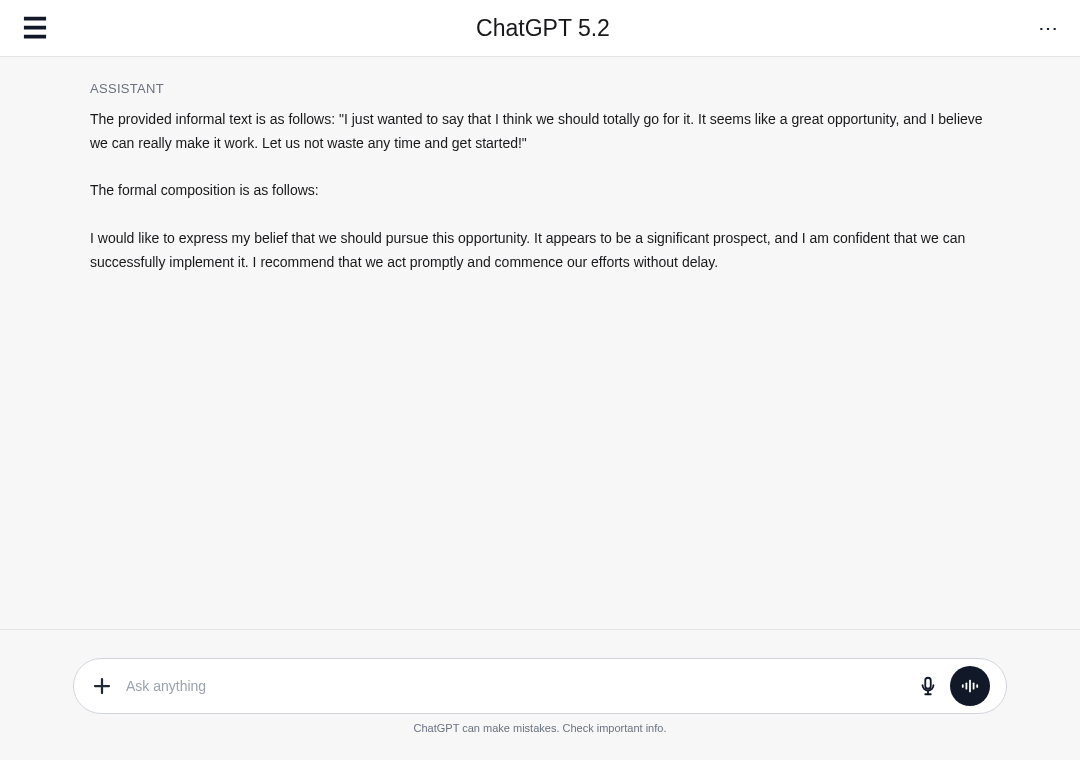
How to Use This Prompt
- [SLANG_REPLACEMENT]: Substituting informal language with formal terms.
- [CONTRACTION_REMOVAL]: Expanding contractions for formality.
- [SENTENCE_STRUCTURE]: Enhancing clarity through improved structure.
- [VOCABULARY_ENHANCEMENT]: Utilizing sophisticated language appropriately.
- [LOGICAL_FLOW]: Ensuring smooth transitions between ideas.
- [PROOFREADING]: Checking for grammatical and punctuation accuracy.
- [FORMAL_TONE]: Adopting a professional writing style.
- [INTENT_MAINTENANCE]: Preserving the original message and intent.
Tips for Best Results
- Eliminate Informal Language: Replace slang and colloquial expressions with sophisticated vocabulary to enhance professionalism.
- Avoid Contractions: Expand all contractions to their full forms to maintain a formal tone throughout the text.
- Enhance Sentence Structure: Revise sentences for clarity and coherence, ensuring proper grammatical structure and logical flow.
- Proofread Thoroughly: Check for grammatical accuracy, punctuation, and adherence to formal writing conventions to ensure a polished final composition.
FAQ
- What is the purpose of formal writing?
The purpose of formal writing is to convey information clearly and professionally, adhering to established conventions. - How can one improve sentence structure?
One can improve sentence structure by ensuring clarity, coherence, and logical flow, while avoiding run-on sentences and fragments. - Why is vocabulary important in formal writing?
Sophisticated vocabulary enhances the tone of formal writing, accurately conveying the intended message without unnecessary complexity. - What should be avoided in formal writing?
In formal writing, one should avoid slang, colloquial expressions, contractions, and overly casual language to maintain professionalism.
Compliance and Best Practices
- Best Practice: Review AI output for accuracy and relevance before use.
- Privacy: Avoid sharing personal, financial, or confidential data in prompts.
- Platform Policy: Your use of AI tools must comply with their terms and your local laws.
Revision History
- Version 1.0 (December 2025): Initial release.
