

Prompt overview
-
Analyzes income, filing status, deductions, and life events to find legal, often‑missed tax savings.
-
Ranks actions by impact and ease, with rough dollar estimates and required documentation.
-
Covers both this year’s quick wins and next year’s planning moves.
Quick Specs
- Media: Text
- Use case: Analysis, Content Strategy, Enhancement
- Industry: Tax Services
- Techniques: Plan-Then-Solve, Role/Persona Prompting, Structured Output
- Models: Claude 3.5 Sonnet, Gemini 2.0 Flash, GPT-4o, Llama 3.1 70B
- Estimated time: 15-30 minutes
- Skill level: Advanced
Variables to fill
-
Annual income and sources: {income_sources}
-
Employment type/status (W‑2, self‑employed, contractor, mixed): {employment}
-
Filing status (single/MFJ/HOH/etc.): {filing}
-
Current deductions and expenses (mortgage interest, SALT, charity, medical, education, childcare, HSA, etc.): {deductions}
-
Financial goals and major life changes (marriage, move, baby, home, education, job change): {goals_changes}
Example variables block (copy and edit)
-
{income_sources}: $145k W‑2 salary + $8k freelance + $3k interest/dividends
-
{employment}: W‑2 with side gig (Schedule C)
-
{filing}: Married filing jointly
-
{deductions}: mortgage interest $11k; SALT $7k; charity $2.5k; HSA $2k; childcare $7k; student loan interest $900
-
{goals_changes}: new baby, plan to buy a home upgrade next year
Prompt template
Act as an expert US tax strategist and CPA focused on maximizing legal tax savings for individuals across income levels and employment types. Build a personalized, prioritized plan with clear steps, estimated savings, and documentation notes. Use a US context and current federal rules; flag items that commonly vary by state.
Inputs
– Income and sources: [income_sources]
– Employment type/status: [employment]
– Filing status: [filing]
– Current deductions/expenses: [deductions]
– Financial goals and major life changes: [goals_changes]
Process
1. Profile snapshot: summarize income mix, filing status, and likely credit/deduction lanes (standard vs. itemize, above‑the‑line deductions, credits).
2. Opportunity scan: evaluate common and advanced areas—retirement contributions (401(k)/403(b)/IRA/SEP/Solo 401(k)), HSA/FSA/DC FSA, child/dependent credits, education credits, QBI for self‑employed, charitable strategies (bunching/DAF), mortgage/SALT caps, energy‑efficient home/vehicle credits, loss harvesting, timing shifts, and withholding/estimated tax alignment.
3. Estimate savings: provide rough federal savings using marginal tax rate bands; note state impact where typical.
4. Prioritize: classify each action as High, Medium, or Low Impact based on potential savings and ease/eligibility.
5. Documentation: list exactly what records or forms are needed for each item.
6. Planning forward: include moves for next year that require setup now (e.g., Solo 401(k), W‑4 changes, quarterly estimates, DAF).
Output format (return this only)
A) Heading: Profile Summary (Plain English)
– One short paragraph restating [employment], [filing], main income sources, and whether standard deduction or itemizing is likely this year.
B) Heading: High Impact (Do These First)
– 5–8 bullets. Each bullet must include: Action | Est. federal savings (USD) | Why it applies | Documentation needed.
Examples to consider as applicable:
– Max traditional 401(k)/403(b)/457 or pre‑tax deferrals; backdoor Roth steps if eligible.
– HSA contributions up to annual limit (if HDHP).
– Child/Dependent Care Credit or Dependent Care FSA coordination.
– SEP‑IRA or Solo 401(k) for self‑employment income (deadline notes).
– QBI deduction optimization for qualified business income (entity/threshold considerations).
– Charitable bunching via Donor‑Advised Fund when near itemization threshold.
C) Heading: Medium Impact (Good Next)
– 5–8 bullets in the same Action | Est. savings | Why | Docs format.
Examples: student loan interest deduction (AGI limits), American Opportunity/Lifetime Learning Credits, energy‑efficient home and EV credits, tax‑loss harvesting in brokerage, shifting income/expenses across year‑end within rules, accountable plan for employee reimbursements (if applicable), spousal IRA.
D) Heading: Low Impact (Nice to Have)
– 4–6 bullets with smaller but legitimate savings (e.g., educator expenses if eligible, small business home office simplified method, subscription/professional dues, job‑related education where allowed, clean recordkeeping to avoid missed credits).
E) Heading: Itemized vs. Standard Deduction Check
Provide a small markdown table comparing this year’s likely totals:
Category | Estimated Amount (USD) | Notes
Rows: Standard Deduction (by [filing]), Mortgage Interest, SALT (capped as applicable), Charitable, Medical (over AGI threshold), Other.
– Conclude with “Likely better to [itemize/claim standard] this year” based on the totals provided.
F) Heading: Withholding and Quarterly Estimates
– Bullets on adjusting W‑4 or making estimated payments to avoid underpayment penalties (safe harbor rules), including due dates (Apr 15, Jun 15, Sep 15, Jan 15).
– Simple rule: align withholding/estimates to 100% of last year’s tax (110% if prior AGI > $150k) or current‑year projection.
G) Heading: Documentation Checklist (What to Gather)
– Income: W‑2s, 1099‑NEC/1099‑K/1099‑INT/1099‑DIV/1099‑B.
– Deductions: mortgage interest Form 1098, property tax statements, charity receipts (contemporaneous), tuition Form 1098‑T, student loan 1098‑E, medical EOBs.
– Business (if any): ledger, receipts, mileage log, home office worksheet, 1099s sent.
– Retirement/HSA: year‑end statements, Form 5498/5498‑SA, plan confirmations.
– Energy/EV: manufacturer certificates, invoices, placed‑in‑service dates.
H) Heading: Planning Moves for Next Year
– 4–8 bullets: open/adjust Solo 401(k) or SEP timing, consider Roth conversions in low‑income years, harvest gains within 0% bracket if eligible, bunch charity with DAF, review insurance and FSA elections, shift RSU sale timing, optimize ESPP disqualifying vs. qualifying dispositions, update W‑4 after life events.
I) Heading: Assumptions and Caveats
– Dollar estimates use federal marginal brackets and do not include state taxes unless specified.
– Credits and limits phase out at higher AGIs; confirm eligibility.
– Educational; not tax or legal advice.
Rules
– Keep language simple and specific; no hype.
– Use USD formatting and round savings to the nearest $50 where appropriate.
– If an input is missing, ask one concise clarifying question at the top, then proceed with clearly labeled assumptions.
– Do not request or process sensitive identifiers.
Sample Output
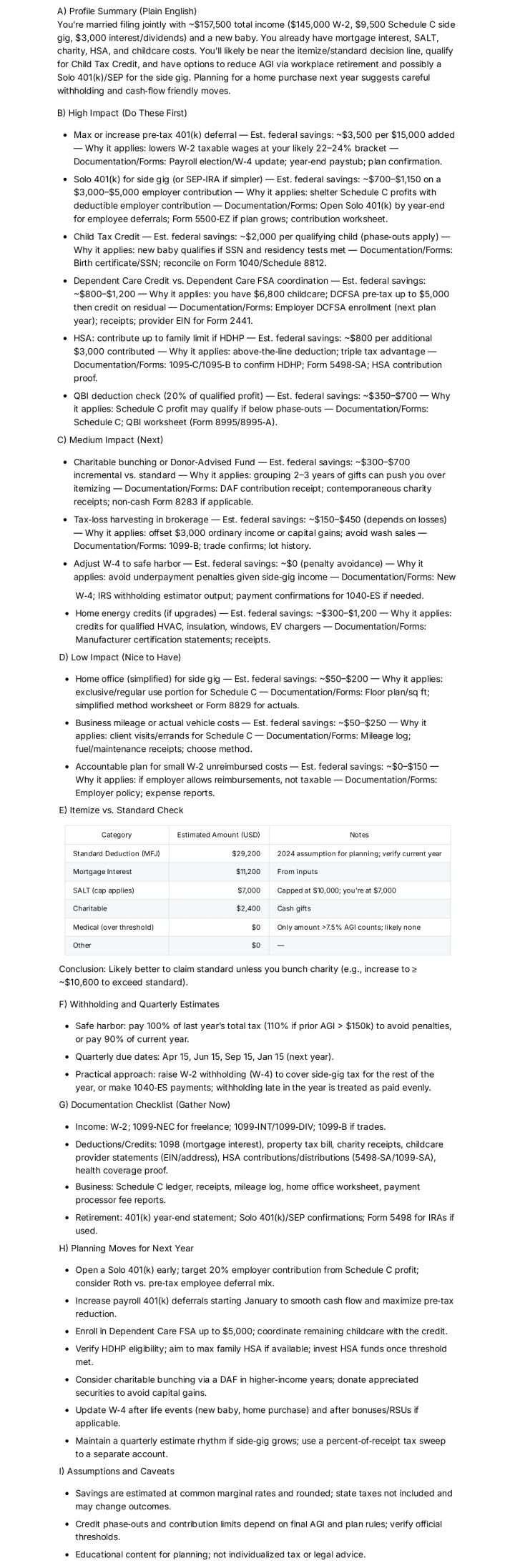
How to use
-
Fill the variables with income mix, filing status, deductions, and goals.
-
Run the prompt; complete High Impact items first, then Medium, then Low.
-
Save documentation as PDFs and keep a checklist for each item.
-
Re‑run after major life changes or before year‑end to update projections.
FAQ
-
Standard vs. itemize—how to decide?
Compare itemizable totals to the standard deduction for {filing}; choose the larger to reduce taxable income. -
Traditional vs. Roth contributions?
Use marginal‑rate now vs. expected future rate; traditional cuts current taxes, Roth favors future tax‑free growth. -
What if there’s side‑gig income?
Consider SEP or Solo 401(k), QBI eligibility, and quarterly estimates to avoid penalties.
Compliance and notes
-
Educational template only; not individualized tax, legal, or accounting advice. Rules can change; verify eligibility.
-
Do not paste Social Security numbers or full account numbers.
Revision history
-
v1.1 – Added impact tiers with doc requirements and itemize vs. standard comparison – 2025‑10‑13
