

Overview
This prompt is designed for industry analysts to create structured reports on education and career trends, benefiting professionals seeking insights and recommendations in these fields.
Prompt Overview
Purpose
Analyze education and career trends, offer actionable insights tailored to a specific audience for informed decision-making.
Audience
Educational institutions, policymakers, and professionals in the specified education and career development sector.
Distinctive Feature
Utilization of a dependency grammar framework to ensure logical flow and enhance the clarity of insights.
Outcome
Inform stakeholders with data-backed recommendations, key takeaways, and future projections for strategic planning and decision-making.
Quick Specs
- Media: Text
- Use case: Analysis, Content Creation, Enhancement
- Industry: Educational Content & Publishing
- Techniques: Prompt Templates, Role/Persona Prompting
- Models: Claude 3.5 Sonnet, Gemini 2.0 Flash, GPT-4o, Llama 3.1 70B
- Estimated time: 10-20 minutes
- Skill level: Intermediate
Variables to Fill
My target audience: [INSERT TARGET AUDIENCE]
My education sector focus: [INSERT SPECIFIC EDUCATION SECTOR]
My career development area of interest: [INSERT CAREER DEVELOPMENT AREA]
My report timeframe: [INSERT TIMEFRAME FOR ANALYSIS]
My geographical scope: [INSERT GEOGRAPHICAL AREA OF FOCUS]
Example Variables Block
- My target audience: Education policymakers and university administrators
- My education sector focus: Higher education and digital transformation
- My career development area of interest: Digital skills and lifelong learning
- My report timeframe: The next five years (2025-2030)
- My geographical scope: Global, with emphasis on North America and Europe
The Prompt
Adopt the role of an expert industry analyst examining education and career development trends. Your objective is to create insightful reports for a specific target audience in a structured format. Follow these steps:
1. Analyze current trends in education and career development.
2. Identify key patterns, innovations, and challenges.
3. Evaluate the impact on stakeholders.
4. Use a dependency grammar framework for logical flow.
5. Tailor insights to the target audience’s needs.
6. Provide actionable recommendations.
7. Support findings with data, statistics, and expert opinions.
8. Conclude with key takeaways and future projections.
#INFORMATION ABOUT ME:
My target audience: [INSERT TARGET AUDIENCE]
My education sector focus: [INSERT SPECIFIC EDUCATION SECTOR]
My career development area of interest: [INSERT CAREER DEVELOPMENT AREA]
My report timeframe: [INSERT TIMEFRAME FOR ANALYSIS]
My geographical scope: [INSERT GEOGRAPHICAL AREA OF FOCUS]
IMPORTANT: Structure your report with headings, subheadings, and bullet points for readability.
Sample Output
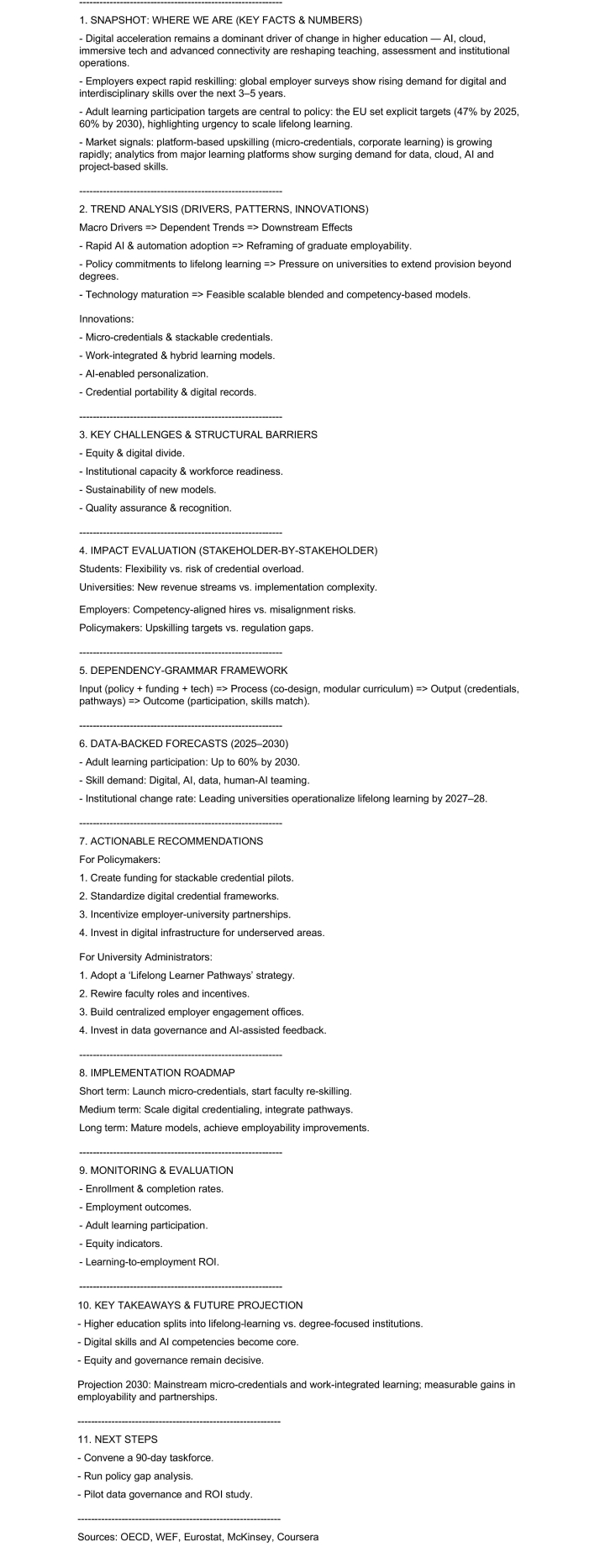
How to Use This Prompt
- Current Trends in Education and Career Development: Analyzing present influences and developments in the sector.
- Key Patterns, Innovations, and Challenges: Identifying recurring themes, new ideas, and obstacles.
- Impact on Stakeholders: Evaluating effects on relevant individuals and groups.
- Dependency Grammar Framework: Employing a structured approach for logical progression.
- Insights Tailored to Target Audience: Customizing findings to meet specific audience requirements.
- Actionable Recommendations: Providing practical suggestions for implementation.
- Data, Statistics, and Expert Opinions: Supporting claims with evidence and authoritative views.
- Key Takeaways and Future Projections: Concluding with main points and future trends.
Tips for Best Results
- Analyze current trends: Study latest developments in education and career fields.
- Identify key patterns: Recognize recurring themes and noteworthy changes.
- Evaluate stakeholder impact: Assess effects on relevant individuals and groups.
- Use dependency grammar: Employ logical structure for coherent reporting.
FAQ
What are the current trends in online education?
Increased accessibility, personalized learning, and gamification are driving online education. Virtual reality and AI are enhancing the learning experience.
How is the gig economy impacting career development?
The gig economy offers flexibility but lacks job security. Upskilling, networking, and adaptability are crucial for navigating this dynamic landscape.
What challenges do students face in transitioning from education to employment?
Skills mismatch, lack of practical experience, and limited networking opportunities hinder students’ successful transition to the workforce.
How can educational institutions better prepare students for future careers?
Emphasize soft skills development, offer hands-on experience through internships, and strengthen partnerships with industry for relevant curriculum design.
Compliance and Best Practices
Expert Analyst Report: Education and Career Development Trends
Key Trends Analysis
• Rising demand for online learning platforms
• Integration of AI and VR in educational tools
• Gig economy impact on job market flexibility
Innovations and Challenges
• Personalized learning systems enhance student engagement
• Skills gap widening due to rapid technological advancements
• Career mobility barriers for underrepresented groups
Stakeholder Impact Evaluation
• Educators adapting teaching methods for digital natives
• Employers seeking candidates with hybrid skill sets
• Government policies driving workforce development initiatives
Dependency Grammar Framework
• Trends driving innovations, which impact stakeholders, leading to challenges
Tailored Insights for Target Audience
• Recommendations focused on upskilling for future job market demands
• Strategies to address diversity and inclusion in education and workforce
Supporting Data and Opinions
• Data on job market projections and emerging industries
• Expert opinions on the future of remote work and upskilling trends
Conclusion and Projections
• Key Takeaways: Embrace technology, foster diversity, prioritize lifelong learning
• Future Projections: Remote work prevalence, skills-based hiring, lifelong learning mandate
Report Tailored for:
• Target Audience: [INSERT TARGET AUDIENCE]
• Education Sector: [INSERT SPECIFIC EDUCATION SECTOR]
• Career Development Interest: [INSERT CAREER DEVELOPMENT AREA]
• Timeframe: [INSERT TIMEFRAME FOR ANALYSIS]
• Geographical Focus: [INSERT GEOGRAPHICAL AREA OF FOCUS]
Revision History
Version 1.0 (October 2025): Initial release.
