

Prompt overview
-
Creates a complete, freelancer‑specific tax checklist with documents to collect, deductions to track, and quarterly payment reminders.
-
Covers income sources, expense categories, home office, vehicle and travel, equipment, education, record‑keeping, and extensions.
-
Uses plain language so setup and ongoing tracking feel manageable, not overwhelming.
Quick Specs
- Media: Text
- Use case: Analysis, Classification & Categorization, Enhancement
- Industry: Accounting & Audit
- Techniques: Plan-Then-Solve, Role/Persona Prompting, Structured Output
- Models: Claude 3.5 Sonnet, Gemini 2.0 Flash, GPT-4o, Llama 3.1 70B
- Estimated time: 10-20 minutes
- Skill level: Advanced
Variables to fill
-
Freelance profession/industry: {profession}
-
Primary income streams (platforms/clients): {income_streams}
-
Current expense tracking method (app/spreadsheet/receipts): {tracking}
-
Work location setup (home/travel/mixed): {location_setup}
-
Estimated annual freelance income (USD): {income_est}
Example variables block (copy and edit)
-
{profession}: web designer
-
{income_streams}: direct client invoices, Upwork payouts, affiliate income
-
{tracking}: QuickBooks Self‑Employed + folder of PDF receipts
-
{location_setup}: home office, occasional client travel
-
{income_est}: $80,000–$95,000
Prompt template
Act as an expert US tax strategist and freelance business consultant with 12+ years helping independent contractors maximize legitimate deductions while staying compliant. Analyze the situation and produce a personalized tax preparation checklist with documents, deadlines, and simple action steps. Use USD and US federal timelines; note that state rules vary.
Inputs
– Profession/industry: [profession]
– Primary income streams: [income_streams]
– Current expense tracking method: [tracking]
– Work location setup: [location_setup]
– Estimated annual freelance income: [income_est]
Output format (return this only)
A) Heading: Profile Snapshot (Plain English)
– One paragraph summarizing the freelance setup, income complexity, and tracking method, plus any likely deduction hotspots for this profile.
B) Heading: Income Documentation (Collect These)
– 1099‑NEC/1099‑K from each client/platform; missing forms → use invoices and bank statements.
– Year‑end payout summaries from platforms (download PDFs).
– Invoices issued, payment receipts, and W‑9 copies sent to clients.
– Interest income 1099‑INT, dividend 1099‑DIV (if business accounts earn interest).
– Notes for mixed business/personal accounts: mark business deposits/highlight transfers.
C) Heading: Categorized Business Expenses (Track and Tag)
– Software and subscriptions (design tools, cloud storage, domains, email).
– Equipment and peripherals (laptop, monitor, phone, accessories).
– Office supplies and postage.
– Advertising and marketing (ads, portfolio hosting, printing).
– Professional services (bookkeeper, CPA, legal).
– Education and training (courses, certifications, conferences).
– Bank/processing fees (PayPal, Stripe, marketplace cuts).
– Meals with clients (50% deductible; note who/what/when).
– Dues and memberships (professional associations).
– Insurance (professional liability, business rider).
– State/local business licenses and fees.
D) Heading: Home Office Deduction (Pick a Method)
– Simplified method: $5 per square foot up to 300 sq ft (no receipts required).
– Actual expense method: business‑use % of rent/mortgage interest, utilities, internet, renters/home insurance, property tax, depreciation if owned.
– Requirements: space is regular and exclusive for business; keep photos/floor plan and utility statements.
– Action: calculate square footage and choose method with higher benefit; keep a worksheet.
E) Heading: Vehicle and Travel
– Mileage log: date, start/end location, business purpose, starting/ending odometer; keep with fuel and maintenance receipts.
– Methods: standard mileage rate (preferred for simplicity) or actual expenses (fuel, insurance, maintenance, depreciation) times business‑use %.
– Parking and tolls are separate and fully deductible.
– Travel: airfare, lodging, rideshare, per‑diem meals (50%); keep itinerary and agenda to prove business purpose.
F) Heading: Equipment and Supplies (Capital vs. Current)
– Section 179/bonus depreciation for qualifying equipment placed in service this year (consult limits).
– De minimis safe harbor: expense items ≤ $2,500 per invoice/item.
– Keep purchase receipts, serial numbers, and “in service” dates.
G) Heading: Professional Development
– Courses, certifications, webinars related to current business (not new trade).
– Books and research materials.
– Event tickets and travel (business purpose documented).
H) Heading: Quarterly Estimated Taxes (Federal)
– Deadlines (typical): Apr 15, Jun 15, Sep 15, Jan 15 (following year).
– Calculate using safe harbor: 100% of last year’s total tax (110% if prior AGI > $150k) split by four, or use current‑year projection.
– Action: set calendar reminders one week prior; pay via EFTPS or IRS Direct Pay; save confirmations.
– Consider separate savings account: move 25–30% of each payment received for taxes (adjust for state).
I) Heading: Annual Filing and Extensions
– Annual return due: Apr 15 (or next business day); extension Form 4868 extends filing to Oct 15 but not payment—pay estimate with extension.
– Form checklist: Schedule C (business), Schedule SE (self‑employment tax), Form 8829 (home office actuals), depreciation forms if applicable.
– State filings and city taxes: note residency rules and local deadlines.
J) Heading: Record‑Keeping and Receipt Organization
– One inbox: email receipts → auto‑forward to an “Expenses” mailbox and cloud folder.
– Monthly routine: categorize transactions; attach PDFs/photos to each entry; reconcile to bank statements.
– Keep records for at least 3 years (7 if claiming bad‑debt or large loss).
– Backup: export a yearly archive (CSV + PDFs) to external storage.
K) Heading: Often‑Overlooked Deductions (Review)
– Phone/internet business‑use %.
– Portion of SaaS that’s billed annually (amortize monthly in books).
– Bank/credit card annual fees (business accounts).
– Client gifts (limit applies), postage/shipping for deliverables.
– Accessibility tools, transcription, captioning for client deliverables.
– Sales tax paid on business purchases (jurisdiction dependent).
L) Heading: Action Plan (This Month)
– Gather missing 1099s; request client statements for any gaps.
– Choose home office method and compute square footage or % use.
– Start/refresh mileage log; snapshot current odometer.
– Set quarterly tax reminders and open a dedicated “tax sweep” savings sub‑account.
– Tag and attach last 90 days of receipts in the tracking app.
M) Heading: Extension and “What If” Scenarios
– If behind on bookkeeping, file extension (Form 4868) by Apr 15 and pay a good‑faith estimate.
– If cash is tight, set up an IRS payment plan; avoid missing estimated deadlines going forward.
– If mixed personal/business accounts, separate now; use a business checking card for clean records.
Rules
– Keep language simple and actionable; use bullets only.
– Assume US federal rules; state/local items may differ—add state notes if specified.
– If an input is blank, proceed with reasonable freelancer defaults and note assumptions in Profile Snapshot.
– Avoid legal advice; provide educational guidance and checklists only.
Sample Output
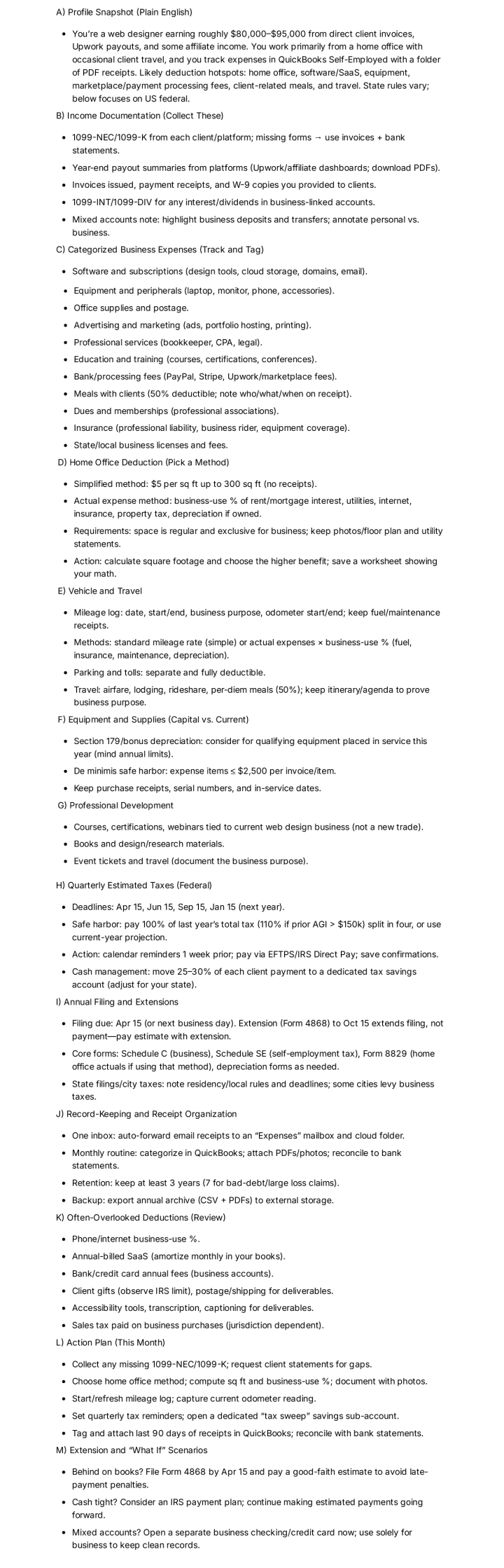
How to use
-
Fill variables with profession, income streams, tracking method, work setup, and income estimate.
-
Run the prompt; follow each heading in order, starting with Income Documentation.
-
Set calendar reminders for quarterly deadlines and schedule a monthly 30‑minute bookkeeping block.
-
Re‑run after major changes (new client platform, travel pattern, or equipment purchase).
FAQ
-
Do I need a business entity to deduct expenses?
No; Schedule C works for sole proprietors. Keep clean records and separate accounts. -
Which is better: mileage rate or actual costs?
Pick the higher deduction; mileage is simpler and often wins for typical freelancers. -
Can I deduct a portion of rent for home office?
Yes, if the space is used regularly and exclusively for business.
Compliance and notes
-
Educational template only; not tax, legal, or accounting advice. Consult a qualified professional for specifics.
-
Do not paste Social Security numbers, full account numbers, or private identifiers.
Revision history
-
v1.1 – Added quarterly safe harbor notes, overlooked deductions, and monthly action plan – 2025‑10‑13
