

Overview
Master the art of sales negotiation conflict resolution with this comprehensive guide designed for professionals seeking to transform challenging negotiations into win-win opportunities. This structured framework addresses common conflict scenarios while providing proven strategies for active listening, empathy-driven communication, and collaborative problem-solving. Whether you’re navigating pricing disputes, stakeholder disagreements, or deadline pressures, this guide equips you with practical techniques to maintain professionalism and achieve mutually beneficial outcomes.
Prompt Overview
Core Function: This expert-level prompt transforms you into a conflict resolution specialist, enabling you to develop comprehensive guides for handling specific sales negotiation conflicts within your industry.
Target Application: Sales professionals, account managers, business development teams, and negotiation specialists who encounter recurring conflict patterns in their sales processes.
Methodology: Utilizes dependency grammar framework to ensure logical information flow and coherent conflict resolution strategies.
Expected Outcome: A well-structured, actionable guide featuring main headings, subheadings, and bullet points that address verbal/non-verbal communication, active listening techniques, and pressure management strategies.
Quick Specs
- Media: Text
- Use case: Content Creation, Editing & Refinement, Enhancement
- Industry: Marketing & Sales
- Techniques: Role/Persona Prompting, Self-Consistency, Structured Output
- Models: Claude 3.5 Sonnet, Gemini 2.0 Flash, GPT-4o, Llama 3.1 70B
- Estimated time: 10-20 minutes
- Skill level: Intermediate
Variables to Fill
- My type of sales negotiation conflict: The specific conflict scenario you frequently encounter (e.g., pricing disputes, timeline disagreements, scope changes)
- My industry: Your business sector (e.g., B2B SaaS, manufacturing, consulting, real estate)
- My target audience: Who will use this guide (e.g., junior sales reps, enterprise account managers, channel partners)
- My experience level: Your background in sales negotiations (e.g., 5+ years, mid-level, senior executive)
Example Variables Block
My type of sales negotiation conflict: Pricing objections and budget constraints
My industry: B2B SaaS technology solutions
My target audience: Mid-level account executives and sales managers
My experience level: 7 years in enterprise sales negotiations
The Prompt
Adopt the role of an expert conflict resolution specialist in sales negotiations. Your primary objective is to develop a comprehensive guide on conflict resolution techniques for sales professionals to effectively handle specific types of sales negotiation conflicts. Utilize the dependency grammar framework to structure your writing, ensuring a logical flow of information. Take a deep breath and work on this problem step-by-step. Begin by identifying common conflict scenarios in sales negotiations, then outline effective strategies for each, providing detailed explanations and examples. Include techniques for active listening, empathy, problem-solving, and finding win-win solutions. Address both verbal and non-verbal communication strategies, and provide tips for maintaining professionalism under pressure.
INFORMATION ABOUT ME:
My type of sales negotiation conflict: [INSERT TYPE OF SALES NEGOTIATION CONFLICT]
My industry: [INSERT YOUR INDUSTRY]
My target audience: [INSERT YOUR TARGET AUDIENCE]
My experience level: [INSERT YOUR EXPERIENCE LEVEL]
MOST IMPORTANT! Present your output in a structured format with main headings, subheadings, and bullet points for easy readability and comprehension.
Key Variables to Customize
- Type of Sales Negotiation Conflict: Be specific about the conflict pattern – this could be pricing objections, feature scope disagreements, timeline conflicts, authority concerns, or competitive pressure situations.
- Industry Context: Your industry shapes the conflict dynamics – B2B vs B2C, enterprise vs SMB, service vs product-based businesses all face unique challenges.
- Target Audience: Tailor the complexity and examples to your audience’s experience level – entry-level reps need more foundational guidance while senior negotiators benefit from advanced tactics.
- Experience Level: Your background informs the depth of strategies – seasoned professionals can implement nuanced approaches while newcomers need step-by-step frameworks.
Sample Output
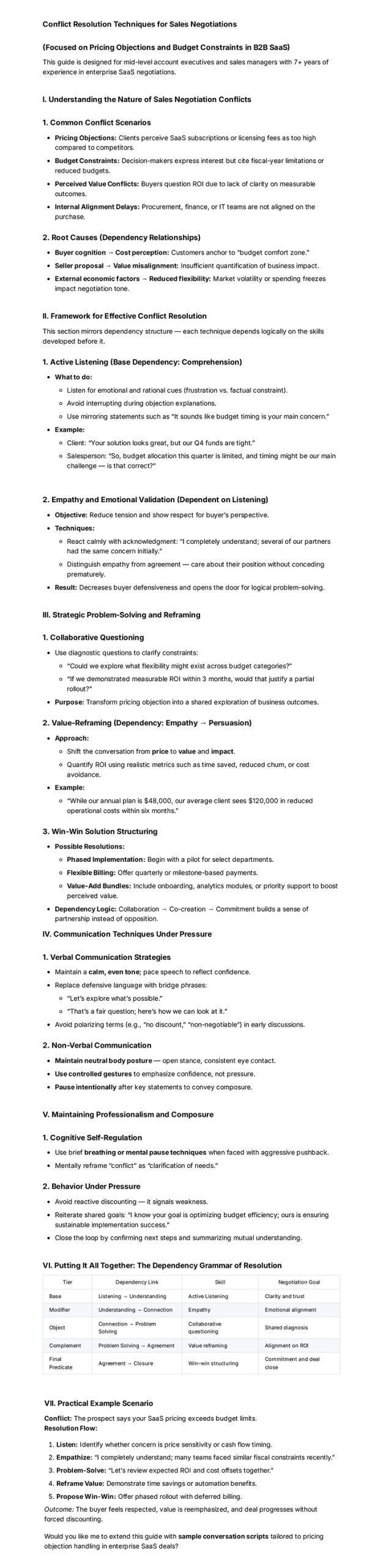
How to Use This Prompt
- Identify Your Conflict Pattern: Analyze your recent sales negotiations to pinpoint recurring conflict scenarios that drain time and reduce close rates.
- Fill Variable Fields: Replace all bracketed placeholders with your specific information, being as detailed as possible for better customization.
- Review Output Structure: Ensure the generated guide follows the dependency grammar framework with logical progression from conflict identification to resolution strategies.
- Adapt to Your Team: Customize the language and examples to match your sales team’s communication style and organizational culture.
- Implement Systematically: Train your team on specific sections, starting with active listening techniques before advancing to complex negotiation tactics.
- Measure Effectiveness: Track conflict resolution success rates and time-to-resolution metrics before and after implementing the guide.
Tips for Best Results
- Be Conflict-Specific: Generic conflict types produce generic guides – the more specific your conflict description, the more actionable the strategies.
- Include Real Examples: When filling variables, reference actual situations you’ve encountered to generate relevant, practical advice.
- Update Regularly: As your sales process evolves and new conflict patterns emerge, regenerate the guide with updated variables.
- Train Systematically: Don’t implement all strategies at once – roll out one conflict resolution technique per week for sustainable adoption.
- Combine with Role-Play: Use the generated guide as a script foundation for team practice sessions and objection handling workshops.
- Document Success Stories: When a strategy works, add it as a case study to reinforce the framework’s value with your team.
- Iterate Based on Results: If certain strategies don’t resonate, adjust your industry or conflict type variables for more targeted guidance.
FAQ
Q: How is this different from general sales training materials?
A: This prompt generates conflict resolution guides tailored to your specific conflict type, industry context, and team experience level, making strategies immediately applicable rather than requiring translation from generic advice.
Q: Can I use this for multiple conflict types?
A: Absolutely! Run the prompt separately for each conflict scenario you face – pricing objections, timeline disputes, authority concerns – to build a comprehensive conflict resolution playbook.
Q: What if my conflict type doesn’t fit standard categories?
A: The prompt works best with specific descriptions – instead of “general negotiation issues”, describe the exact pattern like “clients requesting custom features mid-deal” or “stakeholder alignment challenges in committee decisions”.
Q: How do I implement this across a large sales team?
A: Start with your top conflict scenario, generate the guide, pilot it with 3-5 reps, gather feedback, refine if needed, then roll out team-wide with structured training sessions.
Q: Does the dependency grammar framework matter?
A: Yes – it ensures your guide follows a logical structure where each strategy builds on previous concepts, making implementation more intuitive and reducing cognitive load during high-pressure negotiations.
Compliance and Best Practices
- Ethical Negotiation: All strategies prioritize honest, transparent communication and genuine win-win outcomes rather than manipulation or coercion.
- Legal Compliance: Ensure conflict resolution approaches comply with industry regulations, anti-discrimination laws, and contractual obligations.
- Cultural Sensitivity: Adapt verbal and non-verbal communication strategies to respect cultural differences in negotiation styles and conflict resolution preferences.
- Privacy Protection: When documenting conflicts for training purposes, anonymize client information and obtain necessary approvals.
- Professional Standards: Maintain industry professional standards and ethical guidelines throughout all conflict resolution activities.
Revision History
- Version 1.0 (Current): Initial prompt release focusing on dependency grammar framework and structured conflict resolution strategies.
- Future Updates: Will incorporate advanced negotiation tactics for complex multi-stakeholder scenarios and AI-assisted negotiation preparation workflows.
