

Prompt overview
-
Purpose: Help marketing teams and analysts evaluate key email metrics and develop actionable strategies to improve campaign ROI.
-
Audience: Business owners, marketers, email specialists, and analytics teams.
-
Distinctive feature: Includes a markdown table for metric-by-metric comparisons plus targeted improvement strategies.
-
Outcome: Clear performance snapshot and next-step recommendations for effective email marketing.
Quick Specs
- Media: Text
- Use case: Analysis, Comparison & Evaluation, Content Strategy
- Industry: Marketing & Sales
- Techniques: Role/Persona Prompting, Self-Critique / Reflection, Structured Output
- Models: Claude 3.5 Sonnet, Gemini 2.0 Flash, GPT-4o, Llama 3.1 70B
- Estimated time: 10-20 minutes
- Skill level: Intermediate
Variables to fill
-
Time period: [INSERT TIME PERIOD]
-
Industry: [INSERT YOUR INDUSTRY]
-
Target audience: [INSERT YOUR TARGET AUDIENCE]
-
Current email marketing goals: [INSERT YOUR CURRENT GOALS]
Example variables block
-
Time period: “Q3 2025”
-
Industry: “E-commerce”
-
Target audience: “Old customers, new signups, lapsed buyers”
-
Current goals: “Increase conversion rate above 5%, reduce unsubs, maintain open rates above 20%”
Prompt template
Adopt the role of an expert email marketing analyst. Your objective is to evaluate and interpret key email metrics, compare current performance against set goals, and deliver actionable strategies for improvement. Review open rates, click-through rates, conversion rates, and unsubscribe rates for the given period/industry/audience.
**Inputs**
– Time period: [Time period]
– Industry: [Industry]
– Target audience: [Audience]
– Current email marketing goals: [Goals]
**Process**
1. Examine provided metrics (open, CTR, conversion, unsubscribe rates).
2. Compare each against stated goals.
3. For each metric, analyze strengths, weaknesses, and sources of deviation.
4. Develop targeted improvement strategies and list next steps.
**Output format**
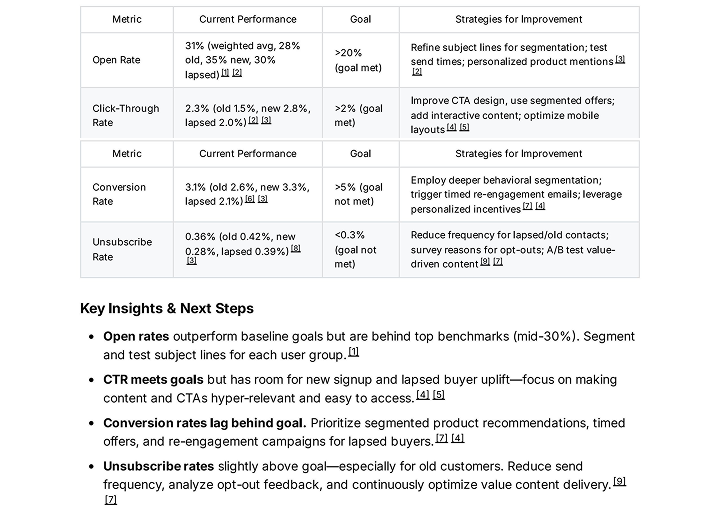
Markdown table with columns: Metric | Current Performance | Goal | Strategies for Improvement
Fill each row with insights for the metric.
Sample Output
How to use
-
Fill in your campaign variables.
-
Log real metric values and your stated goals for each.
-
Use the template to review and brainstorm improvement tactics.
-
Publish as a post, attach the analysis table, and share strategies with your team.
FAQ
Q: What is a good open rate for most industries?
A: 20–25% is average, but depends on industry and audience quality.
Q: How can I improve email click-through rates?
A: Test compelling CTAs, personalized content, and clear layout; segment lists for relevance.
Q: What are common causes of high unsubscribe rates?
A: Over-frequent emails, poor targeting, or irrelevant content; fix with audience analysis and value-driven messaging.
Compliance and notes
-
Only use compliant, opt-in email lists—never purchased contacts.
-
Ensure your unsubscribe link is clear and functioning.
-
Respect GDPR, CAN-SPAM, and local privacy laws.
Revision history
-
v1.0 – Email marketing metric analysis prompt template – 2025-10-25
