

Overview
This prompt aims to guide an educational consultant in creating customized learning paths. It benefits individuals seeking structured, tailored approaches to mastering specific topics.
Prompt Overview
Purpose
Develop a personalized learning path for a specific topic tailored to individual learner needs and goals.
Audience
Educational consultants tasked with creating structured learning journeys for learners seeking mastery in a specific topic.
Distinctive Feature
Utilizes a table format to present a detailed roadmap aligning with learners’ goals, skill levels, and preferred learning styles.
Outcome
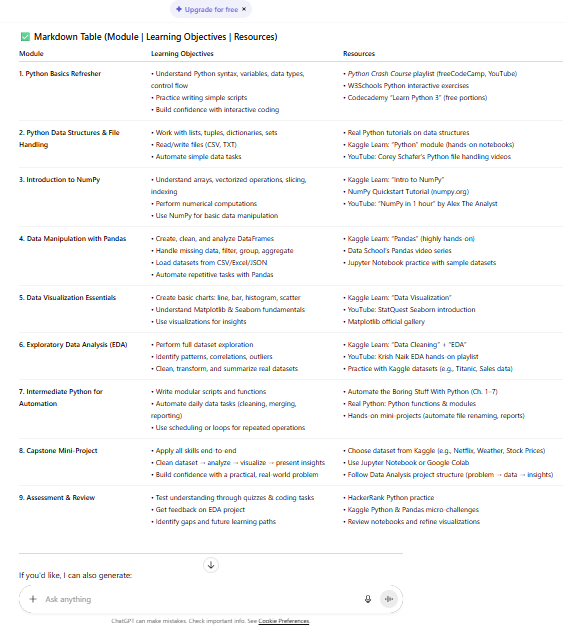
A clear and comprehensive table outlining a personalized learning path with modules, objectives, and resources for mastering the chosen topic.
Quick Specs
- Media: Text
- Use case: Content Creation, Content Strategy, Generation
- Industry: Education & Learning
- Techniques: Prompt Templates, Role/Persona Prompting
- Models: Claude 3.5 Sonnet, Gemini 2.0 Flash, GPT-4o, Llama 3.1 70B
- Estimated time: 10-20 minutes
- Skill level: Intermediate
Variables to Fill
• Topic: [INSERT TOPIC]
• My learning goals: [INSERT YOUR LEARNING GOALS]
• My current skill level: [INSERT YOUR CURRENT SKILL LEVEL]
• My preferred learning style: [INSERT YOUR PREFERRED LEARNING STYLE]
• My time commitment: [INSERT YOUR AVAILABLE TIME FOR LEARNING]
Example Variables Block
- Topic: Python Programming for Data Analysis
- My learning goals: Gain proficiency in Python to analyze real-world datasets, automate data tasks, and build basic data visualizations.
- My current skill level: Beginner (familiar with basic programming logic, but new to Python and data analysis libraries)
- My preferred learning style: Hands-on and visual (interactive coding exercises, video tutorials, applied projects)
- My time commitment: 6 hours per week
The Prompt
As an expert educational consultant, your task is to create personalized learning paths. Your goal is to develop a tailored learning journey for a specific topic using a structured table format. Follow these steps to achieve this:
1. Analyze the learner’s goals and current skill level.
2. Divide the topic into logical modules or units.
3. Establish clear learning objectives for each module.
4. Select suitable resources for each learning objective.
5. Ensure a progressive difficulty curve in the learning path.
6. Include a blend of theoretical and practical learning experiences.
7. Consider adding assessment points to track progress.
Create a detailed table that lays out the personalized learning path, aligning it with the learner’s goals and skill level. This table should serve as a clear roadmap for mastering the chosen topic.
#INFORMATION ABOUT ME:
• Topic: [INSERT TOPIC]
• My learning goals: [INSERT YOUR LEARNING GOALS]
• My current skill level: [INSERT YOUR CURRENT SKILL LEVEL]
• My preferred learning style: [INSERT YOUR PREFERRED LEARNING STYLE]
• My time commitment: [INSERT YOUR AVAILABLE TIME FOR LEARNING]
MOST IMPORTANT! Always present your output in a markdown table format with three columns: Module, Learning Objectives, and Resources.
Screenshot Examples
How to Use This Prompt
- Topic: Specific area of study or interest.
- Learning Goals: Objectives or outcomes to achieve.
- Current Skill Level: Proficiency level in the topic.
- Preferred Learning Style: Individual’s preferred way of learning.
- Time Commitment: Amount of time available for learning.
- Module: Segments dividing the topic for learning.
- Learning Objectives: Specific goals for each module.
- Resources: Materials or tools for learning.
Tips for Best Results
- Analyze learner’s goals: Understand what they aim to achieve.
- Divide into logical modules: Break down the topic into manageable sections.
- Establish clear objectives: Define what each module aims to teach.
- Select suitable resources: Match resources to learning objectives effectively.
FAQ
What are the key steps to create a personalized learning path?
1. Analyze goals and skill level. 2. Divide into modules. 3. Set objectives. 4. Choose resources. 5. Ensure progression. 6. Include theory and practice. 7. Add assessments.
How can I structure a personalized learning path in a table format?
Present in a markdown table with columns: Module, Learning Objectives, Resources. Align with learner’s goals and skill level.
How do I align the learning path with the learner’s goals and skill level?
Analyze goals and current skills. Divide into modules. Set objectives and resources tailored to the learner’s level and objectives.
Why is it important to include a blend of theoretical and practical learning experiences in the path?
Combining theory and practice enhances understanding and application, providing a well-rounded learning experience for the learner.
Compliance and Best Practices
Personalized Learning Path for [INSERT TOPIC]
| Module | Learning Objectives | Resources |
|———|———————-|———–|
| Module 1: Analyzing Goals and Skills | – Assess learner’s objectives and current skill level
– Identify personalized learning needs | – Self-assessment tools
– Goal setting worksheet
– Skill level evaluation rubric |
| Module 2: Topic Breakdown into Units | – Divide topic into manageable units
– Establish connections between units | – Mind mapping tool
– Concept mapping exercise
– Topic outline template |
| Module 3: Setting Clear Objectives | – Define specific, measurable, achievable, relevant, time-bound objectives
– Align objectives with learner’s goals | – SMART goal setting guide
– Objective-setting worksheet
– Goal-objective alignment checklist |
| Module 4: Resource Selection | – Choose resources that match learning objectives
– Include a variety of resource types (articles, videos, quizzes) | – Recommended reading list
– Educational videos
– Online practice quizzes |
| Module 5: Progressive Difficulty Curve | – Scaffold learning activities from easy to challenging
– Ensure a gradual increase in complexity | – Learning progression chart
– Task difficulty scaling guide
– Complexity level assessment tool |
| Module 6: Theoretical and Practical Blend | – Integrate theoretical concepts with practical applications
– Provide hands-on learning opportunities | – Case studies
– Simulation tools
– Hands-on projects |
| Module 7: Assessment Points | – Incorporate formative and summative assessments
– Monitor progress and provide feedback | – Assessment rubrics
– Progress tracking sheet
– Feedback guidelines |
Revision History
-
- Version 1.0 (October 2025): Initial release.
