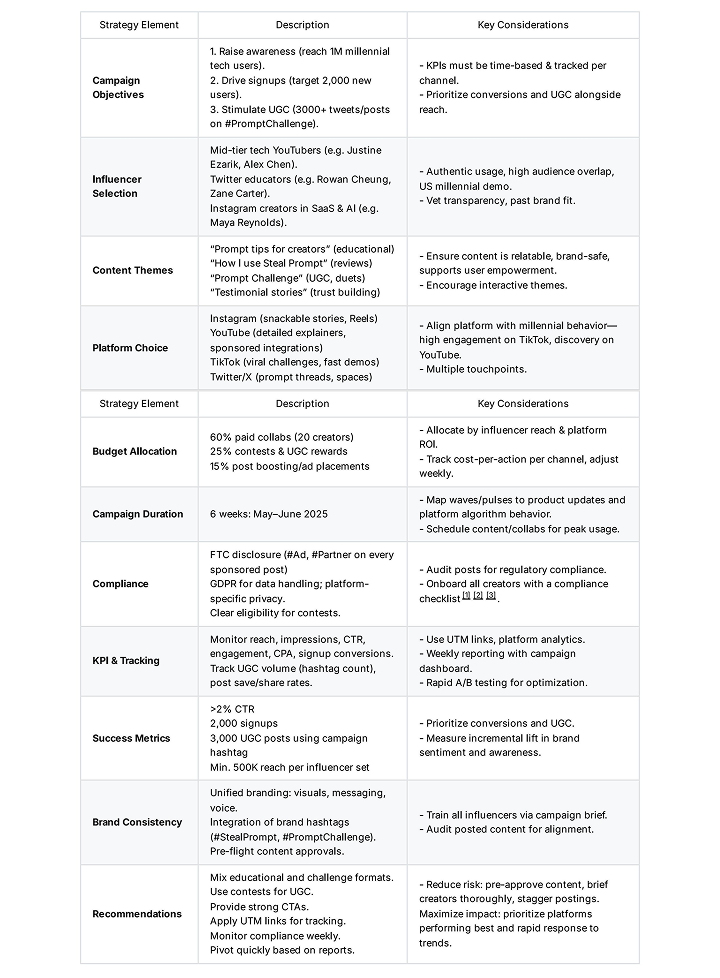
Prompt overview
-
Purpose: Guide strategists in planning and executing successful influencer campaigns—selecting the right creators, optimizing content, and measuring results.
-
Audience: Marketing teams, business owners, campaign managers, and brand builders.
-
Distinctive feature: Uses a strategic framework and a markdown table for element-by-element clarity.
-
Outcome: Clear, actionable campaign plan ready for adaptation and launch.
Quick Specs
- Media: Text
- Use case: Analysis, Content Creation, Content Strategy
- Industry: Marketing & Sales
- Techniques: Structured Output
- Models: Claude 3.5 Sonnet, Gemini 2.0 Flash, GPT-4o, Llama 3.1 70B
- Estimated time: 15-30 minutes
- Skill level: Advanced
Variables to fill
-
Target audience: [INSERT TARGET AUDIENCE]
-
Product/service: [INSERT PRODUCT/SERVICE]
-
Industry: [INSERT INDUSTRY]
-
Campaign budget: [INSERT BUDGET]
-
Campaign duration: [INSERT CAMPAIGN DURATION]
Example variables block
-
Target audience: “Millennial tech users in the US”
-
Product/service: “Steal Prompt – AI Prompt Library”
-
Industry: “Technology / SaaS”
-
Campaign budget: “$30,000”
-
Campaign duration: “6 weeks (May–June 2025)”
Prompt template
Adopt the role of an expert marketing strategist. Develop a detailed influencer campaign for {Product/service} in the [Industry] sector, targeting [Target audience] within a budget of [Campaign budget] over [Campaign duration]. Outline objectives, influencer identification, content themes, metrics, and compliance.
**Inputs**
– Target audience: [Target audience]
– Product/service: {Product/service}
– Industry: [Industry]
– Campaign budget: [Budget]
– Campaign duration: [Duration]
**Process**
1. Set clear campaign objectives (awareness, engagement, conversions).
2. Research and shortlist influencers: platform fit, relevance, audience insights.
3. Define engaging content themes (education, reviews, challenges, testimonials).
4. Establish platforms (Instagram, YouTube, TikTok, Twitter, etc.), match to audience behavior.
5. Develop KPIs and analytics (reach, CTR, engagement, conversions, cost-per-action).
6. Plan communication, brand consistency, and compliance (FTC, GDPR, local regs).
7. Allocate budget, schedule posts, and implement monitoring.
8. Summarize key recommendations and risk mitigations.
### Output format
### Markdown Table – Influencer Campaign Strategy
Strategy Element
Description
Key Considerations
Campaign Objectives
E.g., Increase awareness, drive signups, collect user content
Must be measurable and time-based
Influencer Selection
E.g., Mid-tier tech YouTubers, Twitter educators, Instagram creators
Authenticity, audience overlap
Content Themes
E.g., “Prompt tips”, “How I use AI prompts”, “Prompt challenge”
Engaging, brand-safe, relatable
Platform Choice
E.g., YouTube, Instagram, TikTok, X/Twitter
Match user behavior/demographics
Budget Allocation
E.g., 60% paid collabs, 25% contests, 15% paid boost
Track ROI and per-influencer costs
Campaign Duration
E.g., 6 weeks May–June 2025
Align with launches/events
Compliance
E.g., FTC disclaimers, hashtag rules, privacy, fair use
Review jurisdiction requirements
KPI & Tracking
E.g., Impressions, clicks, conversions, engagement, CPA
Set benchmarks, monitor regularly
Success Metrics
E.g., CTR > 2%, 2000 signups, 3000 user tweets
Prioritize based on goals
Brand Consistency
E.g., Visuals, voice, hashtags, CTA style
Train/brief all influencers
Recommendations
Summarize top tactics: contests, collab variety, UTM links, community events
Mitigate risk and maximize impact