

Prompt overview
-
Builds a multi‑factor scoring model from simple inputs most teams already track.
-
Classifies clients into Low/Medium/High/Critical risk with concrete criteria and playbooks.
-
Sets monitoring cadences, early warning signals, and relationship‑safe collection tactics.
Quick Specs
- Media: Text
- Use case: Analysis, Data Analysis & Insights, Planning & Strategy
- Industry: Banking (Retail & Commercial)
- Techniques: Plan-Then-Solve, Role/Persona Prompting, Structured Output
- Models: Claude 3.5 Sonnet, Gemini 2.0 Flash, GPT-4o, Llama 3.1 70B
- Estimated time: 10-20 minutes
- Skill level: Intermediate
Variables to fill
-
Business type/industry: {industry}
-
Standard payment terms (e.g., Net 30): {terms}
-
Client base characteristics (SMB/enterprise, domestic/international, seasonality): {clients}
-
Current payment tracking (invoicing tool, spreadsheets, AR aging): {tracking}
-
Biggest collections challenges (short text): {challenges}
Example variables block (copy and edit)
-
{industry}: B2B SaaS
-
{terms}: Net 30 with 5‑day grace
-
{clients}: SMBs in US/EU, usage‑based billing, quarterly seasonality
-
{tracking}: Stripe + AR aging report; notes in CRM
-
{challenges}: invoice disputes surface after due date; approval bottlenecks
Prompt template
Act as an expert financial risk analyst and collections specialist with 15 years of Fortune 500 experience in AR analytics. Build a practical, multi‑factor model to predict late payments using data most businesses already collect. Provide clear risk tiers, early warning indicators, and tailored playbooks that protect relationships while improving cash flow.
Inputs
– Business type/industry: [industry]
– Standard payment terms: [terms]
– Client base characteristics: [clients]
– Current payment tracking methods: [tracking]
– Biggest payment challenges: [challenges]
Output format (return this only)
A) Heading: Data You Already Have (Use These Fields)
– Invoice data: invoice date, due date, amount, itemized lines, currency.
– Payment history: days sales outstanding (DSO), average days past due (DPD), % invoices paid late, largest historical delay, write‑offs.
– Behavior signals: time to first reply, reschedule frequency, dispute frequency, approvals chain length, bounced emails, meeting no‑shows.
– Contract terms: prepayment %, discounts, credit limits, auto‑pay on/off.
– Operational signals: product usage drop, unresolved support tickets, project milestone slippage.
– External but free signals: website outages, leadership changes on LinkedIn, public funding/layoff news.
B) Heading: Multi‑Factor Risk Score (0–100)
Assign points per indicator; higher = riskier. Default weights (adjust per [industry]):
– Historical payment behavior (max 30)
Average DPD last 6 invoices: 0 pts (≤0), 10 (1–7), 20 (8–15), 30 (≥16).
Invoice concentration (max 10)
– Any invoice > 20% of monthly revenue: +10.
Disputes and credits (max 10)
– ≥2 disputes last quarter or credits > 2% revenue: +10.
Communication lag (max 10)
– No reply within 5 business days to invoice/reminder: +10.
Usage/engagement decline (max 10)
– 30‑day usage down ≥25%: +10.
Approvals/PO risk (max 10)
– Multi‑step approvals or missing PO: +10.
Term risk (max 10)
– Terms > Net [terms] baseline by +15 days or no auto‑pay: +10.
External strain (max 10)
– Public layoffs/negative news in 60 days: +10.
Score = sum of points (0–100).
C) Heading: Risk Categories and Criteria
– Low (0–19): on‑time or ≤3 days late; stable usage; quick comms.
– Medium (20–39): occasional 4–10 day delays; minor disputes; slower comms.
– High (40–69): frequent 10–20 day delays; approvals/PO issues; usage trending down.
– Critical (70–100): >20 day delays or invoices > 30 days past due; disputes unresolved; negative external signals.
D) Heading: Early Warning Indicators (Monitor Weekly)
– Average DPD rising 3 weeks in a row.
– First‑response time slips beyond 3 business days.
– Usage or purchase volume down > 20% month‑over‑month.
– Repeated “awaiting approval” status beyond 10 days.
– Contacts changing roles or leaving company.
– New dispute within 7 days of invoice.
E) Heading: Playbooks by Risk Category
Use bullets in this pattern: Action — Goal — When — Owner — Script/Notes.
Low risk
– Auto‑pay enrollment — keep DPD ≤ 0 — onboarding — AR — “We can set auto‑pay; cancel anytime.”
– Early pay incentive 1% 10 Net 30 — speed cash — renewal — Sales/AR — cap discount to margin.
Medium risk
– Pre‑due reminder cadence (7/3/1 days) — prevent slips — every invoice — AR — short, friendly messages.
– Approval map capture — remove bottlenecks — first delay — CSM — “Who approves POs and payments?”
– Small credit limit — cap exposure — at contract — Finance — limit growth until on‑time streak.
High risk
– Split invoices/milestones — reduce friction — before project start — Sales/PM — 40/40/20 terms.
– Payment plan with written schedule — collect gradually — when >15 DPD — AR — e‑sign agreement.
– Escalation to senior sponsor — unblock approval — at >10 DPD — Exec — keep relationship tone.
Critical risk
– Stop‑work/hold shipment clause — protect cash — at >30 DPD — Ops — send formal notice.
– COD/prepayment for new orders — prevent exposure — immediately — Sales — allow reversion after 3 on‑time payments.
– Collections partner last resort — recover — at >60 DPD — Finance — provide documentation pack.
F) Heading: Monitoring Protocols and Cadence
– Weekly: risk score refresh; top 10 risers review; new disputes scan.
– Biweekly: call‑down on High/Critical accounts; confirm approval chain and payment date.
– Monthly: AR aging reconciliation; root‑cause analysis for top 5 delays; update weights if false positives.
– Quarterly: evaluate terms (Net 30 vs. Net 45) and auto‑pay penetration; set targets.
G) Heading: Dashboard and Thresholds
Provide a small table: Metric | Target | Trigger
– % invoices on auto‑pay | ≥ 60% | < 50% triggers outreach campaign
– Weighted Average DPD | ≤ 5 days | ≥ 8 days triggers Level‑2 playbook
– AR > 30 days past due | ≤ 8% of AR | ≥ 12% triggers exec review
– Dispute rate | ≤ 1% | ≥ 2% triggers invoice QA audit
H) Heading: Documentation Checklists
– Keep for each client: signed MSA/SOW, PO/approval trail, invoice copies, reminder history, call notes, payment promises, dispute evidence, usage reports.
– Standardize note fields: promised date, reason for delay, next action, owner.
I) Heading: Implementation in 30 Days
– Week 1: backfill DPD and disputes; set baseline scores; pick top 10 high‑risk.
– Week 2: implement reminder cadence and approval maps; launch auto‑pay push.
– Week 3: negotiate payment plans; introduce milestone billing on new work.
– Week 4: review metrics; adjust weights; document SOPs.
Rules
– Keep language simple; use USD where dollar figures are referenced.
– If inputs are missing, proceed with the default weights above and label assumptions.
– This is educational guidance, not legal advice; confirm contract remedies locally.
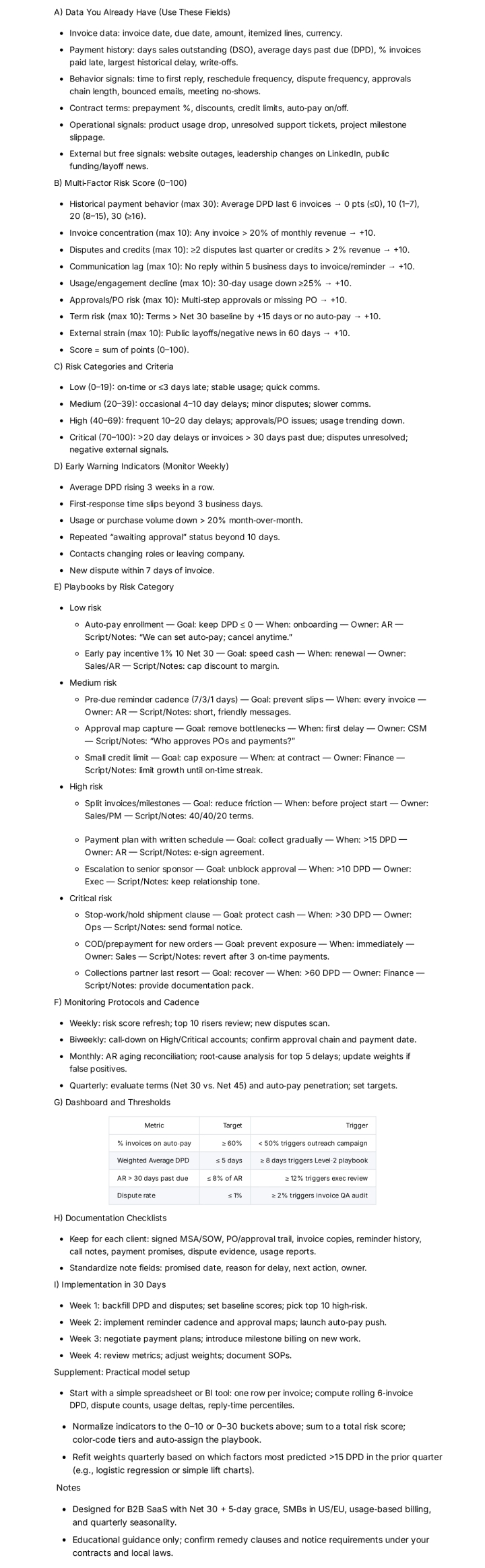
Sample Output:
How to use
-
Fill in variables for industry, terms, client profile, and tracking tools.
-
Paste recent AR aging and note any disputes; run the prompt to score accounts.
-
Work the playbooks by tier, starting with Critical and High, and track results weekly.
FAQ
-
Do I need paid credit checks?
No. The model relies on behavior and internal data; add credit checks only for large exposures. -
How do I avoid damaging relationships?
Use friendly scripts, clear promises, and milestone billing; reserve stop‑work for repeated breaches. -
Can weights change?
Yes. Tune weights quarterly based on which factors best predicted lateness in your data.
Compliance and notes
-
Educational template only; not legal advice. Review contract terms before pausing work or shipments.
-
Do not share confidential client details in public tools.
Revision history
-
v1.1 – Added scoring weights, dashboard thresholds, and 30‑day rollout – 2025‑10‑13
