

Overview
This prompt guides filmmakers in creating visually compelling cinematic portraits. Cinematographers and directors will benefit by enhancing their storytelling through detailed visual descriptions.
Prompt Overview
Purpose: This cinematic portrait aims to capture the essence of the subject in a unique setting.
Audience: The intended audience includes film enthusiasts and those interested in visual storytelling techniques.
Distinctive Feature: The use of reflection surfaces and foreground effects creates a layered visual experience.
Outcome: The final image evokes a specific mood, enhancing the viewer’s emotional connection to the subject.
Quick Specs
- Media: Image
- Use case: Creative Concepts, Generation
- Industry: Content & Media Creation, Film & Television Production
- Techniques: Zero-Shot Prompting
- Models: Claude 3.5 Sonnet, Gemini 2.0 Flash, GPT-4o, Llama 3.1 70B
- Estimated time: 15-30 minutes
- Skill level: Advanced
Variables to Fill
- [SUBJECT_DESCRIPTION] – Subject Description
- [SETTING_DESCRIPTION] – Setting Description
- [TIME_OF_DAY] – Time Of Day
- [REFLECTION_SURFACE] – Reflection Surface
- [FOREGROUND_EFFECT] – Foreground Effect
- [LIGHTING_QUALITY] – Lighting Quality
- [LIGHTING_TARGET] – Lighting Target
- [SHADOW_TREATMENT] – Shadow Treatment
- [CLOTHING_ELEMENTS] – Clothing Elements
- [DOF_SPEC] – Dof Spec
- [ATMOSPHERE_MOOD] – Atmosphere Mood
- [LENS_SPEC] – Lens Spec
- [APERTURE_SPEC] – Aperture Spec
- [FILM_AESTHETIC] – Film Aesthetic
- [AESTHETIC_VIBE] – Aesthetic Vibe
- [COLOR_EFFECT] – Color Effect
Example Variables Block
- [SUBJECT_DESCRIPTION]: young woman with flowers
- [SETTING_DESCRIPTION]: sunny park
- [TIME_OF_DAY]: golden hour
- [REFLECTION_SURFACE]: calm lake
- [FOREGROUND_EFFECT]: blurred leaves
- [LIGHTING_QUALITY]: soft sunlight
- [LIGHTING_TARGET]: her face
- [SHADOW_TREATMENT]: gentle shadows
- [CLOTHING_ELEMENTS]: flowy white dress
- [DOF_SPEC]: shallow depth of field
- [ATMOSPHERE_MOOD]: dreamy and serene
- [LENS_SPEC]: 50mm prime
- [APERTURE_SPEC]: f/1.8
- [FILM_AESTHETIC]: vintage look
- [AESTHETIC_VIBE]: romantic
- [COLOR_EFFECT]: warm tones
The Prompt
Cinematic portrait of a [SUBJECT_DESCRIPTION] in a [SETTING_DESCRIPTION] at [TIME_OF_DAY], shot through [REFLECTION_SURFACE], [FOREGROUND_EFFECT] in the foreground, [LIGHTING_QUALITY] illuminating [LIGHTING_TARGET], [SHADOW_TREATMENT] on [CLOTHING_ELEMENTS], [DOF_SPEC], [ATMOSPHERE_MOOD], [LENS_SPEC] lens at [APERTURE_SPEC], [FILM_AESTHETIC], [AESTHETIC_VIBE], rich contrast, [COLOR_EFFECT].
Example
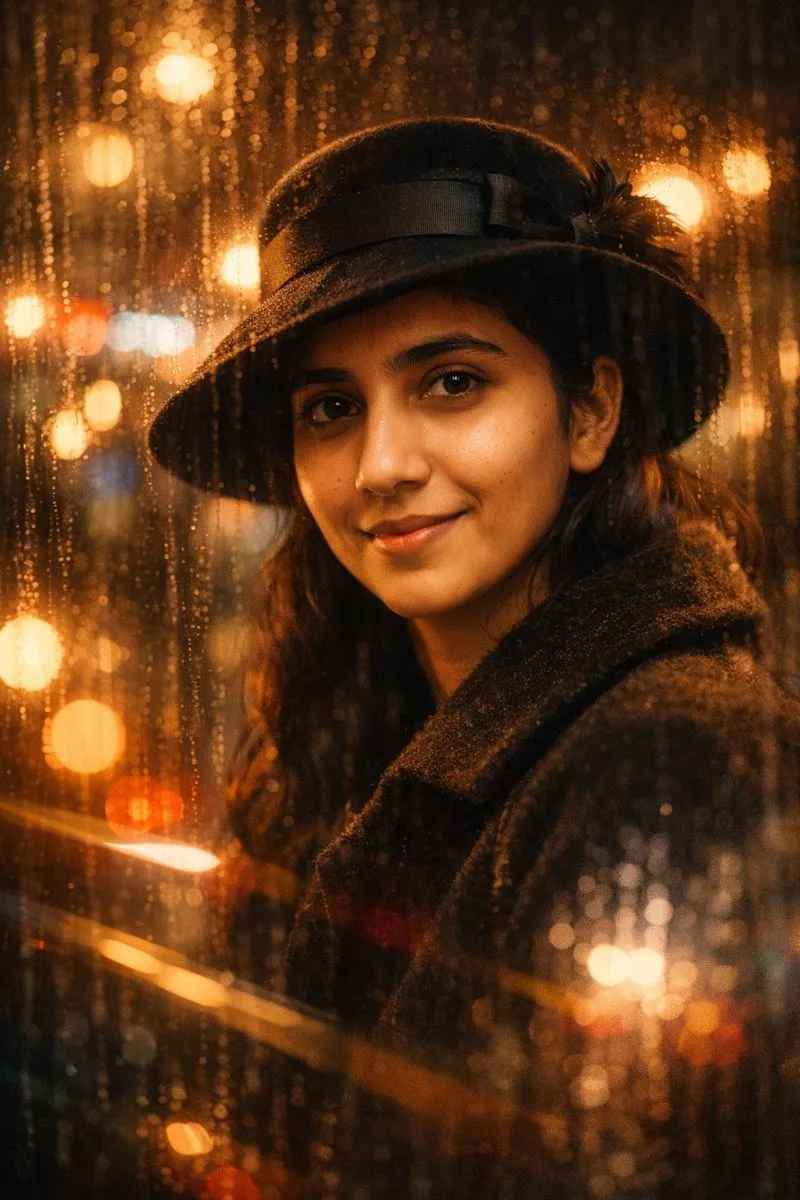
Cinematic portrait of a [woman in a vintage hat] in a [dim urban environment] at [night], shot through [a rain-streaked reflective window], [bokeh lights and elongated motion-blurred light streaks] in the foreground, [soft warm amber light] illuminating [her face], [deep shadows] on [the hat and wool coat], [shallow depth of field], [moody atmosphere], [85mm] lens at [f/1.4], [film grain], [dreamy reflective aesthetic], rich contrast, [soft color bloom].
Input:

Output:
How to Use This Prompt
- [SUBJECT_DESCRIPTION]: characteristics of the main subject.
- [SETTING_DESCRIPTION]: location or environment details.
- [TIME_OF_DAY]: specific time for the scene.
- [REFLECTION_SURFACE]: surface used for reflections.
- [FOREGROUND_EFFECT]: visual elements in the foreground.
- [LIGHTING_QUALITY]: type and quality of light used.
- [ATMOSPHERE_MOOD]: overall emotional tone of the scene.
- [FILM_AESTHETIC]: visual style and film characteristics.
Tips for Best Results
- Subject Focus: Choose a compelling subject that tells a story.
- Setting Selection: Pick a setting that enhances the narrative and mood.
- Lighting Mastery: Utilize natural or artificial light to create depth and interest.
- Composition Techniques: Experiment with angles and framing to draw attention to key elements.
FAQ
- What is a cinematic portrait?
A cinematic portrait captures a subject’s essence in a visually compelling manner, often using artistic techniques. - How does lighting affect a cinematic portrait?
Lighting creates mood and highlights features, enhancing the subject’s presence and emotional impact in the portrait. - What role does atmosphere play in cinematography?
Atmosphere sets the emotional tone and context, influencing how viewers perceive the scene and subject. - Why use reflections in cinematography?
Reflections add depth and complexity, creating visual interest and enhancing storytelling through layered imagery.
Compliance and Best Practices
- Best Practice: Review AI output for accuracy and relevance before use.
- Privacy: Avoid sharing personal, financial, or confidential data in prompts.
- Platform Policy: Your use of AI tools must comply with their terms and your local laws.
Revision History
- Version 1.0 (January 2026): Initial release.
