

Prompt overview
-
Designs a layered alert system with thresholds, automated and manual monitoring, and clear response steps.
-
Predicts when reserves will breach warning levels using simple forecasts and gives escalation paths.
-
Works with any setup: spreadsheets, basic banking alerts, or accounting tools.
Quick Specs
- Media: Text
- Use case: Content Creation, Enhancement, Generation
- Industry: Financial Planning & Advisory
- Techniques: Plan-Then-Solve, Role/Persona Prompting, Structured Output
- Models: Claude 3.5 Sonnet, Gemini 2.0 Flash, GPT-4o, Llama 3.1 70B
- Estimated time: 15-30 minutes
- Skill level: Advanced
Variables to fill
-
Current cash reserves (USD): {cash}
-
Average monthly operating expenses (USD): {opex}
-
Preferred alert threshold (% of monthly expenses): {threshold_pct}
-
Cash flow patterns and seasonality (brief): {patterns}
-
Current financial tracking methods (tools): {tracking}
Example variables block (copy and edit)
-
{cash}: 180000
-
{opex}: 90000
-
{threshold_pct}: 150
-
{patterns}: collections spike at month‑end; Q4 sales surge; Q2 slow
-
{tracking}: bank app + QuickBooks; weekly spreadsheet
Prompt template
Act as an expert financial systems architect who built hedge fund risk tools and now helps small businesses prevent cash‑flow crises. Create a multi‑layer cash reserve alert system with thresholds, monitoring, escalation, and response playbooks. Provide formulas, simple tools, and immediate steps. Use USD and US context.
Inputs
– Cash reserves: [cash]
– Monthly operating expenses: [opex]
– Preferred alert threshold % of monthly expenses: [threshold_pct]
– Cash‑flow patterns/seasonality: [patterns]
– Current tracking methods: [tracking]
Output format (return this only)
A) Heading: Core Thresholds (Formulas and Targets)
– Runway (months) = Cash Reserves ÷ Monthly Operating Expenses.
– Minimum Operating Buffer (USD) = [threshold_pct]% × [opex].
– Hard Floor (USD) = 1.0 × [opex] (must never be breached).
– Safety Band (USD) = 2.0 × [opex] (target buffer).
– Working Capital Guardrail: AR Days + Inventory Days − AP Days ≤ 45 (adjust for industry).
– State today’s values for Runway, Min Buffer, Safety Band, Hard Floor using [cash] and [opex].
B) Heading: Warning Levels and Triggers
– Level 1 – Caution: Cash < Safety Band OR Runway < 3.0 months OR forecast shows breach in ≤ 60 days.
Actions: weekly monitoring, discretionary spend freeze list, accelerate collections.
– Level 2 – Alert: Cash < Min Buffer OR Runway < 2.0 months OR forecast breach in ≤ 30 days.
Actions: cost trims switch on, price/discount policy tightened, convert AR to cash, lock vendor terms.
– Level 3 – Critical: Cash < Hard Floor OR Runway < 1.0 month OR missed payroll risk.
Actions: emergency plan (funding draw, term renegotiations, pause non‑core projects, management war room).
C) Heading: Monitoring Mechanisms (Automated + Manual)
– Bank alerts: daily low‑balance and large‑withdrawal alerts set to Safety Band and Hard Floor.
– Spreadsheet (works today):
Columns: Date, Opening Cash, Inflows (by source), Outflows (by category), Net, Ending Cash, Runway.
– Formula: Ending Cash = Opening Cash + Inflows − Outflows; Runway = Ending Cash ÷ [opex].
– Rolling 13‑week forecast (see Section D).
Accounting tool rules (if available): tag “discretionary” vs. “essential” vendors; schedule weekly cash report.
Calendar: weekly 15‑minute “cash check” with the owner; monthly threshold review.
D) Heading: 13‑Week Cash Forecast (Simple and Reliable)
– Build a weekly sheet with rows Week 1–13 and columns: Opening, Receipts, Payroll, Rent, COGS, Marketing, Debt Service, Other, Net, Ending, Runway.
– Receipts assumptions: use average of last 8 weeks, then apply seasonal factor from [patterns]; reduce by 10% in slow periods.
– Sensitivity rows: −10%, −20%, −30% receipts; +10% expense shock.
– Warning formula: If any week’s Ending < Min Buffer, flag Level 2; if < Hard Floor, Level 3.
– Review forecast every Monday; update with actuals on Friday.
E) Heading: Escalation Protocols (Who Does What, When)
– Ownership:
CFO/Owner: approve actions at Level 2+, run scenario review.
– AR Lead: collections and terms outreach.
– Ops Lead: discretionary spend freeze and vendor talks.
Communication cadence:
– Level 1: email summary to leadership weekly.
– Level 2: daily 10‑minute stand‑up; board update weekly.
– Level 3: war room; twice‑daily check until stabilized.
Documentation: 1‑page log with date, trigger breached, actions taken, next review time.
F) Heading: Response Playbooks by Level
Use bullets in this pattern: Action — Estimated effect — Timeline — Risk — Notes.
Level 1 – Caution (stabilize in 14 days)
– Accelerate AR: 2% 10 Net 30 for top customers — +$10k–$50k cash — 1 week — Medium — Cap discount to margin.
– Pause low‑ROI ads/subscriptions — +$2k–$8k/mo — 3 days — Low — Keep core channels.
– Term review: tighten discounting; deposit for large orders — +1–2 weeks cash runway — 1 week — Low.
Level 2 – Alert (extend runway to 2–3 months)
– Vendor renegotiation +15 days terms — +$20k–$60k timing benefit — 2 weeks — Medium.
– Price test +3% on leaders with bundle value — +1 pt gross margin — 2 weeks — Medium.
– Hiring freeze/OT cut; reschedule to demand — +$5k–$20k/mo — 1–2 weeks — Medium.
– Defer non‑essential capex — preserve cash — immediate — Low.
Level 3 – Critical (protect payroll, 30–60 days)
– Draw line of credit or revenue‑based financing — +$100k–$300k liquidity — 1–2 weeks — Medium — Only with repayment plan.
– Lease/rent concession or sublet — +$5k–$15k/mo — 4–8 weeks — Medium/High.
– Stop low‑margin SKUs/projects — +1–3 pts net — 1 week — Medium.
– Temporary furloughs/cross‑training — +$8k–$25k/mo — 2–4 weeks — High — Protect core ops.
G) Heading: Manual Backup (If Tools Fail)
– Daily bank balance screenshot to shared folder; log inflows/outflows in a simple sheet.
– Cash jar method for small teams: two budget columns per week (Essential vs. Discretionary); do not spend outside Essential when Level 2+.
– Paper checklist on wall: thresholds, triggers, phone tree, lender contacts.
H) Heading: Implementation Steps (Day 1 to Week 4)
– Day 1
Compute Safety Band, Min Buffer, Hard Floor using formulas in Section A.
– Turn on bank alerts at Safety Band and Hard Floor levels.
– Create 13‑week forecast template; fill Week 1 with known bills and receivables.
Week 1
– Tag discretionary vendors; list quick‑pause items.
– Start weekly cash review (15 minutes) and set owner for each alert level.
Week 2
– Launch AR acceleration (incentives + reminder cadence).
– Begin vendor term talks and subscription audit.
Week 3–4
– Run price test and labor scheduling changes.
– Document escalation phone tree and war‑room SOP.
I) Heading: Example Calculations (using your inputs)
– With [cash] and [opex]:
Runway = [cash] ÷ [opex] months.
– Min Buffer = ([threshold_pct]/100) × [opex] USD.
– Safety Band = 2 × [opex] USD.
– Hard Floor = 1 × [opex] USD.
Place these four numbers at the top of the forecast sheet for quick reference.
J) Heading: Dashboard Snapshot (Track Weekly)
Provide a small table: Metric | Current | Target | Trigger
– Ending Cash | [auto from sheet] | ≥ Safety Band | < Safety Band → Level 1
– Runway (months) | [auto] | ≥ 3.0 | < 2.0 → Level 2
– AR > 30 days | [auto] | ≤ 8% of AR | ≥ 12% → Level 2
– Discretionary spend | [auto] | ≤ 5% of opex | ≥ 8% → freeze list
Rules
– Keep language simple and numbers concrete; round to whole dollars and one decimal where helpful.
– If any input is missing, ask one concise question, then proceed with labeled assumptions.
– Educational planning only; not legal, tax, or financing advice.
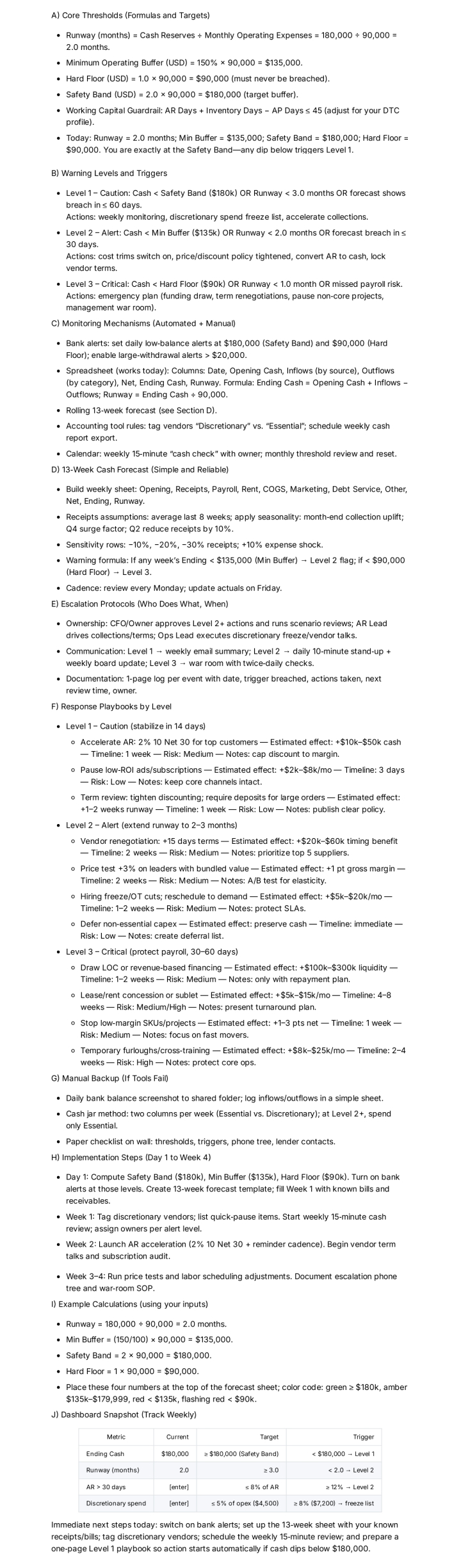
Sample Output
How to use
-
Fill the variables with cash, monthly expenses, threshold %, patterns, and tracking tools.
-
Run the prompt and copy the thresholds, forecast template, and playbooks into a spreadsheet or doc.
-
Review the dashboard weekly; escalate actions when triggers fire; de‑escalate after two healthy weeks.
-
Revisit thresholds quarterly or after major business changes.
FAQ
-
How big should the buffer be?
A common target is 2–3 months of expenses; use your {threshold_pct}% as the minimum and grow toward the Safety Band. -
What if revenue is seasonal?
Lower receipt assumptions in slow weeks and add a separate “seasonal reserve” line during peak months. -
Can this work without accounting software?
Yes—bank alerts plus a 13‑week spreadsheet are enough to start; upgrade tools later.
Compliance and notes
-
This template is educational and not financial, legal, or lending advice.
-
Do not share bank account numbers or private identifiers.
Revision history
-
v1.1 – Added 13‑week forecast, three alert levels, and Day‑1 setup guide – 2025‑10‑13
