
Overview
This prompt guides educational consultants in constructing collaborative feedback cycles for enhanced peer learning strategies. Consultants, educators, and students benefit from systematic feedback mechanisms aligned with learning objectives.
Prompt Overview
Purpose:
Design effective peer learning strategies aligned with learning objectives in educational settings.
Audience:
Educational consultants seeking to implement collaborative feedback cycles for peer learning improvement.
Distinctive Feature:
Utilizing dependency grammar principles to hierarchically organize recommendations for structured feedback cycles.
Outcome:
Clear instructions for implementing and evaluating collaborative feedback cycles to enhance peer learning and knowledge sharing.
Quick Specs
Media:: Text
Use case: Educational consulting
Techniques: Dependency grammar, feedback framework
Models: GPT-4, DALL·E 3, BERT
Estimated time: 45 minutes
Skill level: Advanced
Variables to Fill
No variables required – This prompt works as-is.
Example Variables Block
This prompt works without variables.
The Prompt
Improved prompt:
As an expert educational consultant, your task is to design collaborative feedback cycles. Your goal is to propose effective peer learning and knowledge sharing strategies systematically. Follow these steps:
1. Analyze the subject matter and educational setting to determine key learning objectives.
2. Develop a framework for collaborative feedback cycles that align with the identified objectives.
3. Utilize principles of dependency grammar to organize your recommendations.
4. Offer precise instructions for implementing the feedback cycles.
5. Recommend techniques for evaluating the peer learning process.
#INFORMATION ABOUT ME:
• My subject: [INSERT SUBJECT]
• My educational setting: [INSERT EDUCATIONAL SETTING]
• My target audience: [INSERT TARGET AUDIENCE]
• My learning objectives: [INSERT KEY LEARNING OBJECTIVES]
IMPORTANT: Present your suggestions using a dependency grammar framework, arranging them hierarchically to illustrate the relationships within the collaborative feedback cycles.
Sample Output
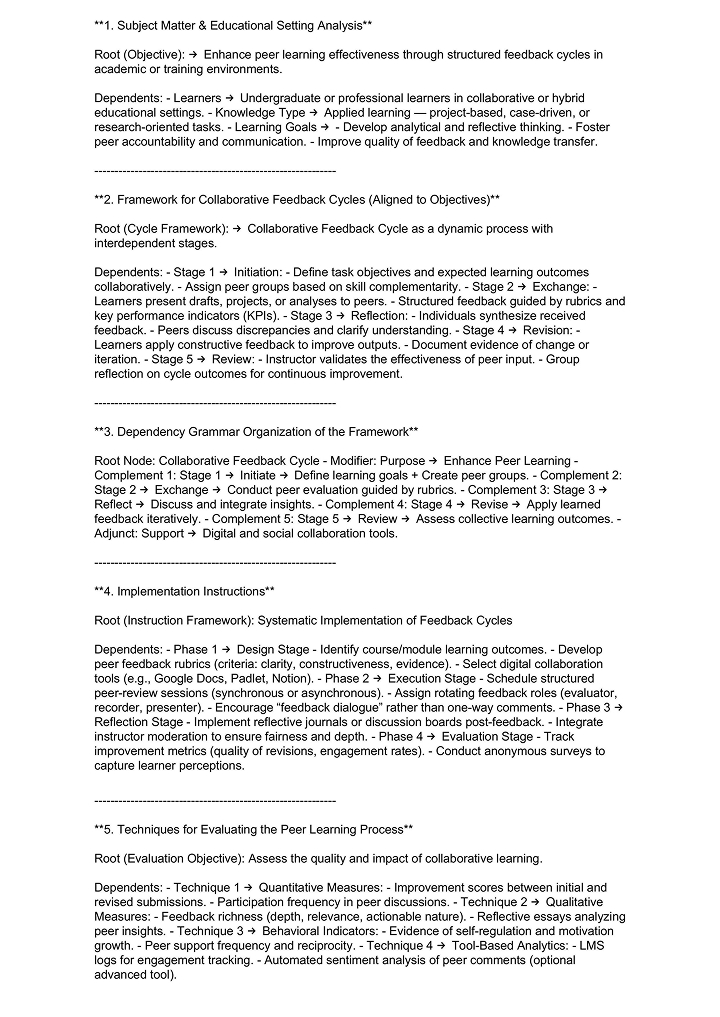
How to Use This Prompt
-
-
- Subject: The specific subject matter for analysis.
-
-
-
- Educational Setting: Description of the learning environment.
-
-
-
- Target Audience: The individuals who will participate in the feedback cycles.
-
-
-
- Learning Objectives: Key goals and outcomes to achieve.
-
-
-
- Dependency Grammar: Framework for structuring recommendations hierarchically.
-
-
-
- Recommendations: Precise guidelines for implementing feedback cycles.
-
-
-
- Peer Learning Techniques: Strategies for effective knowledge sharing among peers.
-
-
-
- Evaluation Methods: Techniques for assessing the peer learning process.
-
Tips for Best Results
-
-
- Analyze learning objectives: Identify key goals and outcomes.
-
-
-
- Develop feedback framework: Create a structured feedback system.
-
-
-
- Utilize dependency grammar: Organize recommendations effectively.
-
-
-
- Provide implementation guidance: Offer clear instructions for executing cycles.
-
FAQ
Understand the subject’s core concepts and context within the educational environment to identify key learning objectives.
What steps can I take to develop a framework for collaborative feedback cycles?
Outline a structured plan aligning feedback methods with learning objectives, ensuring a cohesive and goal-oriented approach.
How can principles of dependency grammar be applied to organize feedback cycle recommendations?
Use dependency relationships to show the hierarchy of feedback elements, highlighting dependencies and interactions for effective implementation.
What precise instructions should I provide for implementing collaborative feedback cycles?
Detail the sequence of activities, roles, and responsibilities, emphasizing clear communication and coordination among participants.
Compliance and Best Practices
-
-
- Best Practice: Analyze subject matter and educational setting to determine key learning objectives.
-
-
-
- Compliance: Develop a framework aligning collaborative feedback cycles with identified objectives.
-
-
-
- Privacy: Utilize dependency grammar principles to organize and present feedback cycle recommendations.
-
Revision History
-
- Version 1.0 (October 2025): Initial release.