
Overview
This prompt guides educational researchers in designing experiments to test teaching methods’ impact on learning outcomes in specific settings. Researchers and educators will benefit from a structured approach to conducting effective educational research.
Prompt Overview
Purpose
To design an experiment testing the effectiveness of a teaching method on a learning outcome in an educational setting.
Audience
Educational researchers and professionals interested in improving teaching methods and learning outcomes.
Distinctive Feature
In-depth focus on research design, participant selection, and data analysis for assessing teaching method efficacy.
Outcome
Clear understanding of how the teaching method impacts the learning outcome, with insights for educational practice improvement.
Quick Specs
Media:: Text
Use case: Educational research design
Techniques: Experimental design, data analysis
Models: GPT-4, DALL·E 3, BERT
Estimated time: 60 minutes
Skill level: Intermediate
Variables to Fill
My teaching method: [INSERT TEACHING METHOD]
• My learning outcome: [INSERT LEARNING OUTCOME]
• My educational setting: [INSERT EDUCATIONAL SETTING]
• My target student population: [INSERT TARGET STUDENT POPULATION]
• My time frame for the experiment: [INSERT TIME FRAME]
Example Variables to Fill
| Teaching Method | Flipped Classroom |
| Learning Outcome | Improvement in Critical Thinking Skills |
| Educational Setting | High School Science Classes |
| Target Student Population | 10th-grade students |
| Time Frame for Experiment | 8 weeks |
The Prompt
Adopt the role of an expert educational researcher tasked with designing an experiment to test the effectiveness of a specific teaching method on a particular learning outcome in a given educational setting. Take a deep breath and work on this problem step-by-step. Here’s a structured approach to guide you through the process:
• Research Question and Hypotheses:
Clearly define the research question and hypotheses related to the impact of the teaching method on the learning outcome.
• Participants:
Outline participant selection criteria, including details about the target student population and any specific inclusion/exclusion criteria.
• Groups and Randomization:
Describe the control and experimental groups, as well as the randomization procedures to ensure unbiased results.
• Data Collection Methods:
Detail the methods for collecting data, specifying the instruments or tools that will be used for measurement.
• Intervention Process:
Describe the intervention process, including the duration, frequency, and any specific activities involved in implementing the teaching method.
• Data Analysis:
Explain the data analysis techniques that will be employed to evaluate the results of the experiment.
• Confounding Variables:
Consider potential confounding variables and outline strategies to control for them during the experiment.
• Ethical Considerations:
Ensure that your experimental design adheres to ethical guidelines for educational research to protect the rights and well-being of participants.
#INFORMATION ABOUT ME:
• My teaching method: [INSERT TEACHING METHOD]
• My learning outcome: [INSERT LEARNING OUTCOME]
• My educational setting: [INSERT EDUCATIONAL SETTING]
• My target student population: [INSERT TARGET STUDENT POPULATION]
• My time frame for the experiment: [INSERT TIME FRAME]
MOST IMPORTANT!: Provide your experimental design in a structured format with clear headings for each section (e.g., Research Question, Hypotheses, Participants, Methods, Data Analysis, Ethical Considerations).
Sample Output
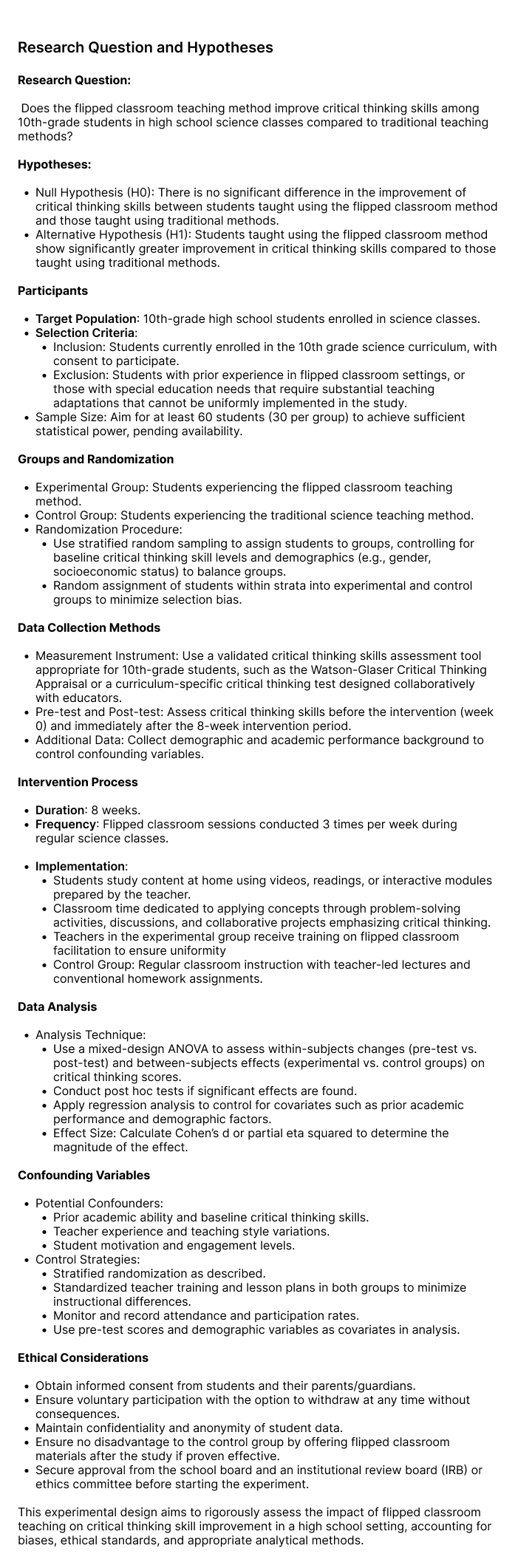
How to Use This Prompt
-
-
- Research Question and Hypotheses: Impact of [Teaching Method] on [Learning Outcome].
- Participants: Criteria for [Target Student Population] selection.
- Groups and Randomization: Define control and experimental groups with randomization.
- Data Collection Methods: Specify tools for measuring outcomes.
- Intervention Process: Detail duration, frequency, and activities of [Teaching Method].
- Data Analysis: Techniques for evaluating experiment results.
- Confounding Variables: Identify and control potential confounding variables.
- Ethical Considerations: Ensure adherence to ethical guidelines in research.
-
Tips for Best Results
Research Question and Hypotheses: Clearly define impact of teaching method on learning outcome.
Participants: Outline selection criteria for target student population.
Groups and Randomization: Describe control vs experimental groups and randomization procedures.
Data Collection Methods: Detail tools and methods for data collection.
FAQ
Research Question and Hypotheses:
Investigate if [TEACHING METHOD] improves [LEARNING OUTCOME] compared to traditional methods. Hypothesis: Students exposed to [TEACHING METHOD] will show higher proficiency.
Participants:
Target students from [TARGET STUDENT POPULATION]. Inclusion criteria: [CRITERIA]. Exclusion: [CRITERIA].
Groups and Randomization:
Control group: traditional teaching. Experimental group: [TEACHING METHOD]. Randomization: random assignment to groups.
Data Collection Methods:
Pre/post-tests, observations, surveys. Measure [LEARNING OUTCOME] using rubrics, quizzes, and self-assessment tools.
Intervention Process:
[TEACHING METHOD] duration: [TIME FRAME]. Frequency: [FREQUENCY]. Activities: [ACTIVITIES]. Ensure consistency and fidelity in implementation.
Compliance and Best Practices
Best Practice Clearly define research question and hypotheses for impact assessment of teaching method on learning outcome.
Compliance Adhere to ethical guidelines for educational research to protect participant rights and well-being.
Privacy Ensure confidentiality and anonymity of participant data throughout the experiment duration.
Revision History
Version 1.0 (October 2025): Initial release.