

Prompt overview
-
Purpose: Educate marketing automation professionals about essential chatbot security and data privacy measures.
-
Audience: Marketing technologists, automation engineers, compliance officers, AI developers.
-
Distinctive feature: Builds from foundational security concepts to advanced policies using a structured dependency grammar approach.
-
Outcome: Clear guidance covering threats, mitigation techniques, regulatory considerations, with real-world examples and action plans.
Quick specs
-
Media: Technical Guide (Text)
-
Use case: Cybersecurity, marketing automation compliance, chatbot governance
-
Taxonomies: Chatbot Security, Data Privacy, Marketing Automation, Compliance, Risk Management
-
Categories: Industry Focus, Security Challenges, Compliance Standards
Variables to fill
-
Target audience: [INSERT TARGET AUDIENCE]
-
Industry focus: [INSERT INDUSTRY FOCUS]
-
Current security challenges: [INSERT CURRENT SECURITY CHALLENGES]
-
Compliance requirements: [INSERT COMPLIANCE REQUIREMENTS]
-
Level of technical expertise: [INSERT LEVEL OF TECHNICAL EXPERTISE]
Example variables block
-
Target audience: “Marketing automation managers and AI developers”
-
Industry focus: “E-commerce SaaS platforms”
-
Current security challenges: “Sensitive customer data leakage, unauthorized access”
-
Compliance requirements: “GDPR, CCPA”
-
Level of technical expertise: “Intermediate to advanced”
Prompt template
Act as an expert cybersecurity consultant specializing in chatbot security and data privacy. Develop a comprehensive guide for [Industry focus] professionals on securing marketing automation chatbots and protecting user data.
**Inputs**
– Target audience: [Target audience]
– Industry focus: [Industry focus]
– Current security challenges: [Current security challenges]
– Compliance requirements: [Compliance requirements]
– Technical expertise level: [Level of technical expertise]
**Process**
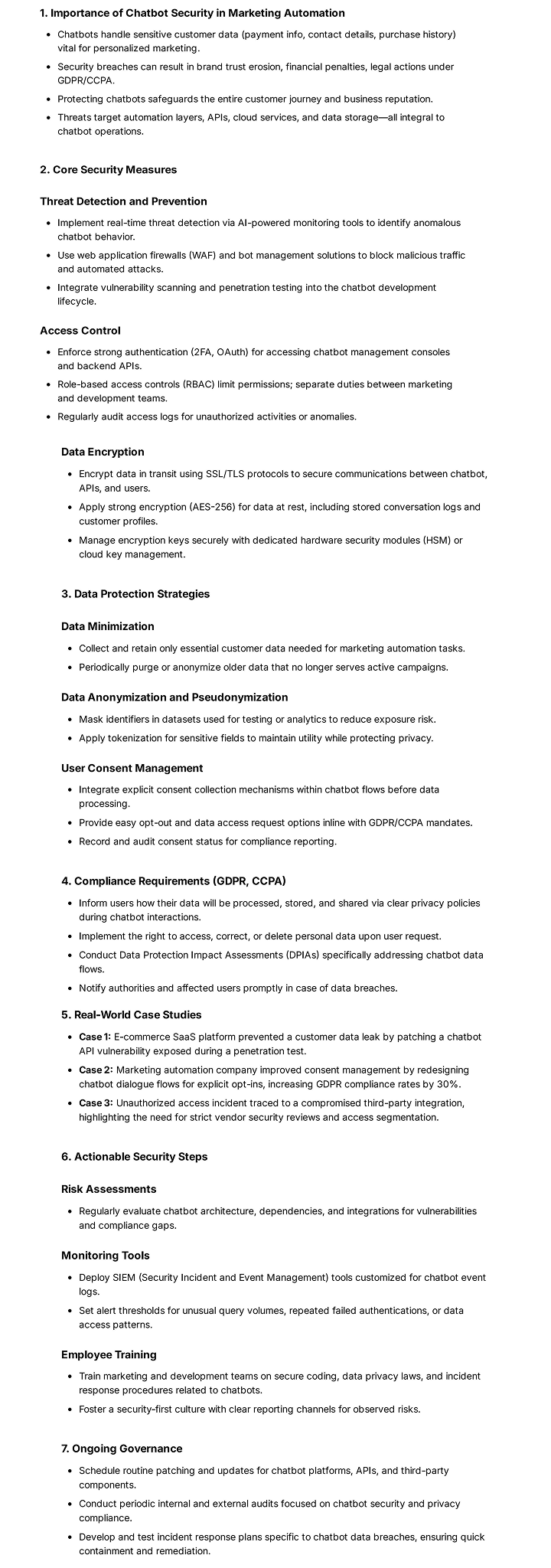
1. Outline the importance of chatbot security in marketing automation.
2. Detail security measures: threat detection, access control, data encryption.
3. Explain data protection strategies: data minimization, anonymization, user consent management.
4. Clarify compliance requirements relevant to the industry (GDPR, CCPA, etc.).
5. Provide case studies or examples illustrating key risks and mitigations.
6. Highlight actionable steps: risk assessments, implementation of monitoring tools, employee training.
7. Emphasize ongoing governance including patching, audits, and incident response.
**Output format**
Sections with subheadings and bullet-point details per step, arranged logically with clear connections between concepts.
Sample Output
How to use
-
Fill in your specific details: Insert your target audience, industry focus, current security challenges, compliance needs, and technical expertise into the variables section.
-
Follow the structured process: Starting with an overview of chatbot security importance, proceed through each outlined security measure, data protection strategy, and compliance requirement step-by-step.
-
Leverage examples: Use the practical examples and case studies provided as benchmarks or discussion points in your internal security reviews or training.
-
Apply actionable steps: Implement the recommended protocols, conduct risk assessments, and establish ongoing security monitoring as per the guide.
-
Review and update regularly: Cybersecurity is dynamic; revisit the guide periodically, update with new best practices, and audit compliance consistently.
FAQ
-
Why is chatbot security critical in marketing automation?
Because chatbots handle sensitive customer data and automate interactions, vulnerabilities can lead to data breaches and regulatory penalties. -
What are typical data privacy challenges for chatbots?
Ensuring user consent, data retention limits, anonymization, and secure transmission/storage are key challenges. -
How often should chatbot security be audited?
Regularly, at least quarterly or after major updates or incidents.
Compliance and notes
-
Always tailor practices to local and international regulations affecting user data.
-
Ensure privacy policies and terms of use reflect chatbot data handling.
-
Maintain transparency with users on data usage and opt-out options.
-
Keep up to date on emerging security threats.
Revision history
-
v1.0 – Initial expert chatbot security and privacy guide template – 2025-10-25
Quick Specs
- Media: Text
- Use case: Compliance Review, Content Creation, Enhancement
- Industry: Cybersecurity Services
- Techniques: Plan-Then-Solve, Prompt Templates, Role/Persona Prompting
- Models: Claude 3.5 Sonnet, Gemini 2.0 Flash, GPT-4o, Llama 3.1 70B
- Estimated time: 10-20 minutes
- Skill level: Intermediate
