

Prompt overview
-
Purpose: Help users create viral, logically structured Twitter threads that drive awareness and engagement.
-
Audience: Business owners, marketers, social media managers, and anyone aiming to increase their reach on Twitter.
-
Distinctive feature: Uses dependency grammar for flow, integrates hashtags and mentions for discoverability, and ensures every tweet has a purpose.
-
Outcome: A cohesive, template-based Twitter thread with actionable user variables for branding and growth.
Quick Specs
- Media: Text
- Use case: Content Creation, Generation, Planning & Strategy
- Industry: Entertainment & Content
- Techniques: Chain-of-Thought, Role/Persona Prompting, Structured Output
- Models: Claude 3.5 Sonnet, Gemini 2.0 Flash, GPT-4o, Llama 3.1 70B
- Estimated time: 10-20 minutes
- Skill level: Intermediate
Variables to fill
-
Topic: [INSERT TOPIC FOR TWITTER THREAD]
-
Business type: [INSERT TYPE OF BUSINESS]
-
Target audience: [INSERT TARGET AUDIENCE]
-
Brand voice: [DESCRIBE YOUR BRAND VOICE]
-
Key message: [INSERT MAIN MESSAGE OR GOAL OF THE THREAD]
Example variables block
-
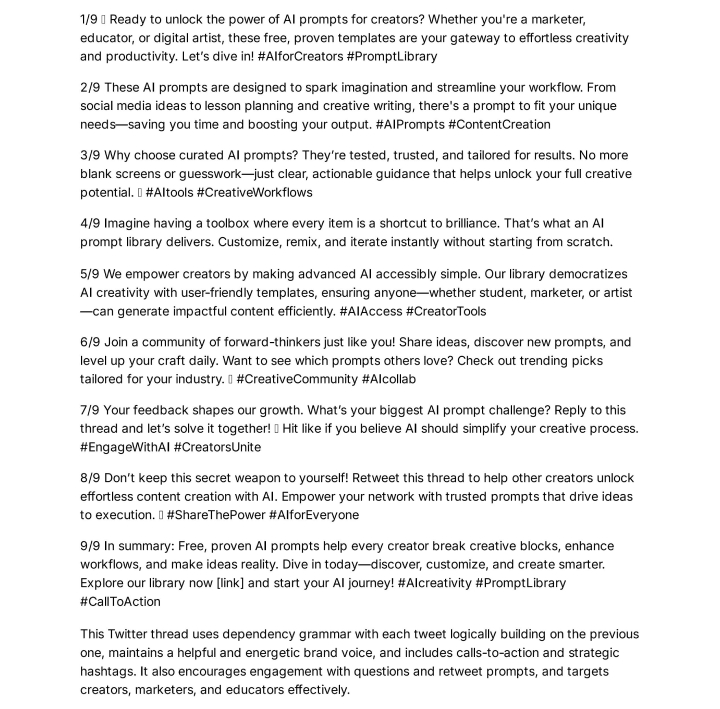
Topic: “Unlocking AI Prompts for Creators”
-
Business type: “AI Tool/Prompt Library”
-
Target audience: “Creators, marketers, educators”
-
Brand voice: “Helpful, clear, energetic, trustworthy”
-
Key message: “Empower everyone to create with AI using free, proven prompt templates.”
Prompt template
Act as an expert social media strategist. Create a viral Twitter thread to boost brand awareness and drive engagement for a [Business type]. Use the dependency grammar framework so each tweet logically builds on the last. Include relevant hashtags, strategic mentions, and compelling calls-to-action throughout.
**Inputs:**
– Topic: [Topic]
– Business type: [Business type]
– Target audience: [Target audience]
– Brand voice: [Brand voice]
– Key message: [Key message]
**Process:**
1. Write an attention-grabbing opening tweet.
2. Expand on key points in each subsequent tweet—each tweet must flow logically from the last (dependency grammar).
3. Add strategic hashtags for visibility.
4. Mention key influencers or relevant Twitter accounts to extend reach.
5. Insert at least two calls-to-action inviting replies, likes, retweets, or clicks.
6. Conclude with a strong summary, recap of the main message, and a final CTA.
**Output format:**
Numbered list of tweets, each within Twitter’s 280-character limit.
Sample Output
How to use
-
Fill in the variables with your own topic, business type, audience, voice, and key message.
-
Customize hashtags and mentions to fit your industry and campaign.
-
Copy the entire output and paste it into your Twitter scheduling tool or thread composer.
-
Monitor performance and adapt future threads using engagement insights.
-
Respond to replies, retweets, and new followers promptly to maximize momentum.
FAQ
Q: What is a dependency grammar framework for Twitter threads?
A: It means every tweet is meaningfully connected, so the reader is encouraged to keep scrolling—threads feel like a story, not disconnected facts.
Q: Why use hashtags and mentions?
A: Hashtags boost discoverability, and mentions (influencers, collaborators) can increase reach by tapping into relevant communities.
Q: What makes a Twitter thread go viral?
A: Clear flow, high value per tweet, compelling openings, CTAs, and conversations with the audience are key. Use eye-catching starts and actionable engagement cues.
Compliance and notes
-
Ensure all content is original or attributed; do not misrepresent product or service capabilities.
-
Avoid false claims and be transparent with any endorsements or affiliate links.
-
Follow Twitter’s guidelines and avoid sensitive topics unless you are certain they are appropriate for your brand and region.
Revision history
-
v1.0 – Viral Twitter thread prompt template for brand engagement – 2025-10-25
