

Overview
Launch effective email campaigns with this personalized outreach framework. This strategic approach helps email marketers craft compelling, relationship-building messages that resonate with target customers and drive conversions. Perfect for growth marketers, sales teams, and business development professionals who need systematic methods for creating personalized email campaigns that cut through inbox clutter and build meaningful customer relationships.
Prompt Overview
Core Function: Positions you as an email marketing strategist to develop personalized email campaigns with dependency grammar structure for clarity, customer-centric messaging, and clear conversion pathways.
Target Application: Email marketers, growth marketers, SDRs, and business development teams running outbound email campaigns.
Expected Outcome: Detailed email templates with clearly marked personalization sections, structured using dependency grammar framework for optimal clarity and coherence.
Quick Specs
- Media: Text
- Use case: Content Creation, Content Strategy, Editing & Refinement
- Industry: Marketing & Sales
- Techniques: Prompt Templates, Role/Persona Prompting
- Models: Claude 3.5 Sonnet, Gemini 2.0 Flash, GPT-4o, Llama 3.1 70B
- Estimated time: 10-20 minutes
- Skill level: Intermediate
Variables to Fill
- My target customers: Who you’re reaching (e.g., VP of Sales at mid-market SaaS companies, E-commerce store owners with 10-50 employees)
- My product/service: What you’re promoting (e.g., Sales engagement platform, Inventory management software, Marketing consultation)
- My unique selling proposition: Key differentiator (e.g., 40% faster sales cycles, AI-powered forecasting, 24/7 support included)
- My company background: Credibility builders (e.g., Trusted by 500+ companies, Founded by former Salesforce VP, $20M Series B funded)
- My campaign goals: What you want to achieve (e.g., Book 20 demos this quarter, Generate 100 qualified leads, Launch in new vertical)
Example Variables Block
My target customers: Marketing Directors at B2B SaaS companies (50-200 employees) struggling with attribution and ROI measurement
My product/service: Multi-touch attribution platform with native integrations to major marketing and sales tools
My unique selling proposition: Only attribution platform with real-time Slack alerts and automatic budget reallocation recommendations
My company background: Trusted by 200+ B2B SaaS companies including Intercom, Segment, and Drift. Featured in TechCrunch and Forbes.
My campaign goals: Generate 50 qualified demo requests in Q4, achieve 25% email-to-meeting conversion rate
The Prompt
Adopt the role of an expert email marketing strategist tasked with initiating a personalized email outreach campaign. Your primary objective is to create tailored emails that promote a specific product or service while building meaningful relationships with target customers. To achieve this, utilize the dependency grammar framework to structure your writing, ensuring each email is precisely crafted to address the recipients unique needs and interests. Take a deep breath and work on this problem step-by-step: 1. Analyze the target customers profile and identify key pain points or interests. 2. Craft a compelling subject line that resonates with the recipients needs. 3. Develop a personalized introduction that demonstrates knowledge of the recipients business or situation. 4. Present the product or service as a solution to their specific challenges or goals. 5. Use the dependency grammar framework to structure your sentences, ensuring clarity and coherence. 6. Include social proof or case studies relevant to the recipients industry. 7. End with a clear call-to-action that encourages further engagement. 8. Proofread and refine the email for maximum impact and personalization.
INFORMATION ABOUT ME:
My target customers: [INSERT TARGET CUSTOMER DESCRIPTION]
My product/service: [INSERT PRODUCT/SERVICE DETAILS]
My unique selling proposition: [INSERT UNIQUE SELLING PROPOSITION]
My company background: [INSERT BRIEF COMPANY BACKGROUND]
My campaign goals: [INSERT SPECIFIC CAMPAIGN GOALS]
MOST IMPORTANT! Provide your output as a detailed email template with clearly marked sections for personalization, ensuring each part adheres to the dependency grammar framework for optimal structure and clarity.
How to Use This Prompt
- Research target customer profiles, pain points, and industry trends
- Fill in variable fields with specific, detailed information about your offering and audience
- Run the prompt to generate initial email template
- Customize personalization sections with actual prospect research
- A/B test subject lines and CTAs to optimize performance
- Track open rates, reply rates, and conversion metrics
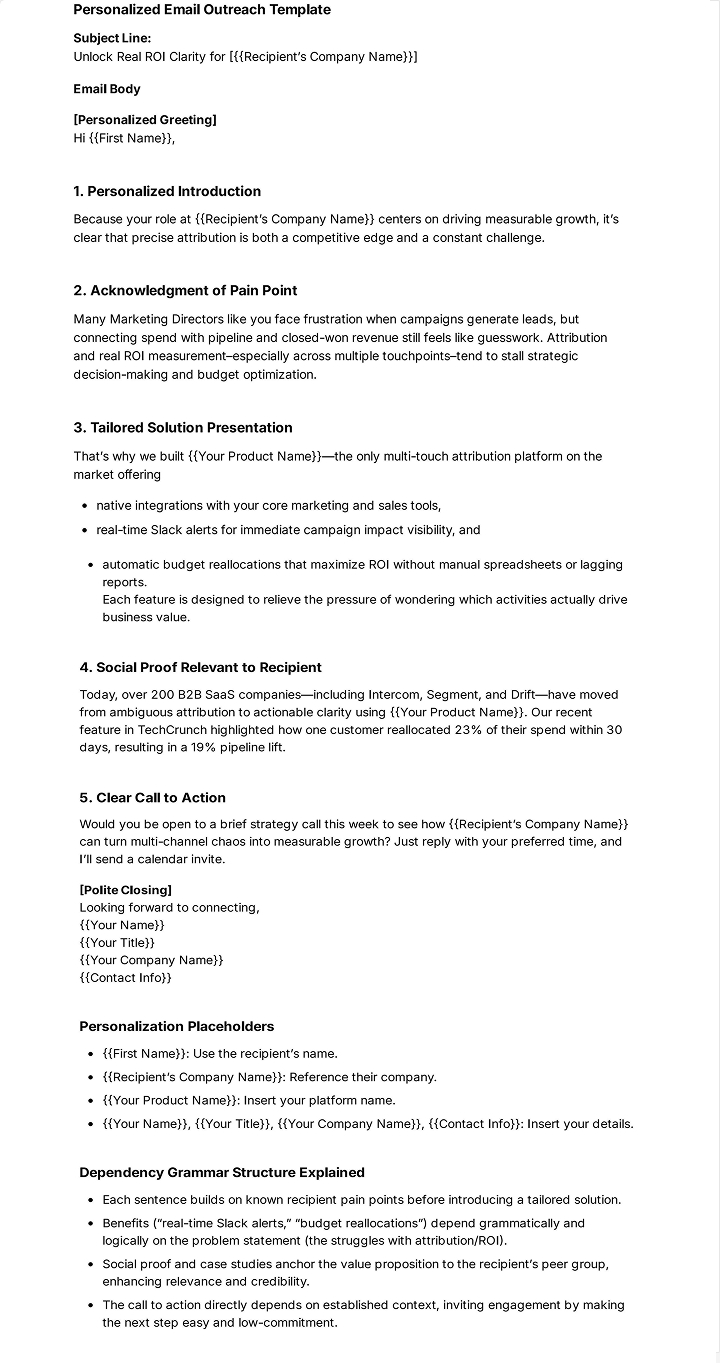
Sample Output
Tips for Best Results
- Personalize beyond first name – reference company news, recent hires, product launches
- Keep emails scannable – use short paragraphs, bullet points where appropriate
- Lead with value, not features – focus on their problems, not your product
- Use specific numbers and results – “32% reduction” beats “significant improvement”
- Make the CTA specific and low-friction – “Book 10-minute overview” beats “Let’s chat”
- Test send times – B2B emails perform best Tuesday-Thursday 10am-2pm local time
- Follow up systematically – most conversions happen on touch 3-5, not touch 1
FAQ
Q: How many personalization points should each email include?A: Aim for 3-5 specific personalization elements beyond name – company details, recent news, industry challenges, role-specific pain points.
Q: What’s a good email length for cold outreach?A: 75-125 words typically performs best. Long enough to demonstrate value, short enough to respect recipient time.
Q: Should I include links in initial emails?A: Minimize links in first touch (1 CTA maximum) to avoid spam filters. Increase links in follow-ups once relationship is established.
Q: How do I avoid sounding salesy?A: Focus on their world (challenges, goals) for 70% of email, your solution for 30%. Use collaborative language (“Would it be valuable…” vs “I want to sell you…”).
Compliance and Best Practices
- Follow CAN-SPAM Act – include unsubscribe link, physical address, accurate sender information
- Respect GDPR requirements for EU contacts – obtain proper consent before outreach
- Honor unsubscribe requests immediately – both legally required and builds trust
- Never purchase email lists – focus on building quality, permission-based lists
- Avoid spam triggers – excessive caps, multiple exclamation points, “free” and “guaranteed”
- Test emails before sending – check spam score with tools like Mail Tester
Revision History
- Version 1.0 (Current): Initial release with dependency grammar framework for personalized email campaigns
