

Overview
Unlock market opportunities with this systematic segmentation framework. This data-driven approach helps market analysts identify and analyze distinct customer segments based on demographics, psychographics, and purchasing behavior. Perfect for marketers, product managers, and business strategists who need structured insights to target the right audiences, optimize messaging, and maximize marketing ROI.
Prompt Overview
Core Function: Positions you as a market analyst to systematically segment target markets and identify high-value customer groups with clear characteristics and potential.
Target Application: Marketing strategists, product managers, market research analysts, and business development teams.
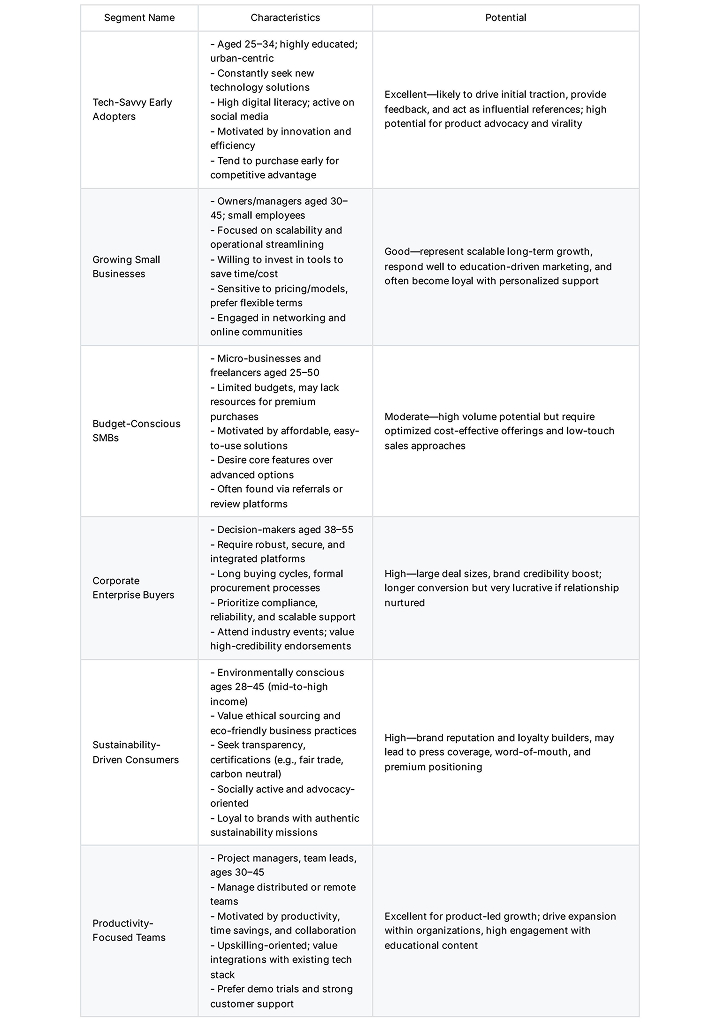
Expected Outcome: Comprehensive market segmentation presented in markdown table format with Segment Name, Characteristics, and Potential columns.
Quick Specs
- Media: Text
- Use case: Analysis, Classification & Categorization
- Industry: Universal / Cross-Industry
- Techniques: Prompt Templates, Role/Persona Prompting, Structured Output
- Models: Claude 3.5 Sonnet, Gemini 2.0 Flash, GPT-4o, Llama 3.1 70B
- Estimated time: 10-20 minutes
- Skill level: Intermediate
Variables to Fill
- My target market: Who you’re analyzing (e.g., B2B software buyers, Millennial homeowners, Small business owners)
- My product/service: What you’re selling (e.g., Project management software, Sustainable fashion, Financial planning services)
- My business context: Your situation (e.g., Startup entering new market, Established brand repositioning, New product launch)
- My marketing goals: What you want to achieve (e.g., Increase market share, Improve targeting efficiency, Launch in new geography)
Example Variables Block
My target market: B2B SaaS decision makers in mid-market companies
My product/service: AI-powered customer support automation platform
My business context: Series B startup expanding from SMB to mid-market segment
My marketing goals: Achieve 30% market penetration in target segment within 18 months, increase average deal size by 3x
The Prompt
Adopt the role of an expert market analyst tasked with segmenting a target market. Your primary objective is to analyze the market and identify key segments for a specific product or service based on various factors. Take a deep breath and work on this problem step-by-step. Begin by thoroughly examining the target market, considering demographics, psychographics, and purchasing behavior. Use this information to create distinct market segments. For each segment, determine its unique characteristics and assess its potential value for the product or service. Organize your findings in a clear, structured format to provide actionable insights for marketing strategies.
INFORMATION ABOUT ME:
My target market: [INSERT TARGET MARKET]
My product/service: [INSERT PRODUCT/SERVICE]
My business context: [DESCRIBE YOUR BUSINESS CONTEXT]
My marketing goals: [DESCRIBE YOUR MARKETING GOALS]
MOST IMPORTANT! Present your output in a markdown table format with 3 columns: Segment Name, Characteristics, and Potential. Ensure each segment is clearly defined and differentiated.
Sample Output
How to Use This Prompt
- Gather existing market research, customer data, and competitive intelligence
- Fill in variable fields with specific market and business information
- Run the prompt to generate initial segmentation analysis
- Validate segments with actual customer data and market research
- Prioritize segments based on strategic fit and resource constraints
- Develop segment-specific marketing strategies and messaging
Tips for Best Results
- Use real customer data to validate segment characteristics – avoid assumptions
- Ensure segments are mutually exclusive and collectively exhaustive
- Focus on actionable differences – segments must require different strategies
- Assess segment size, growth potential, and competitive intensity
- Consider your company’s unique strengths when evaluating segment attractiveness
- Update segmentation quarterly as market dynamics evolve
FAQ
Q: How many segments should I create?A: Start with 3-5 primary segments. Too many dilutes focus; too few misses opportunities. Refine over time based on market feedback.
Q: What if segments overlap?A: Refine your segmentation criteria to create clearer distinctions. Focus on the primary differentiating characteristics.
Q: Should I target all identified segments?A: No – prioritize 1-2 segments initially based on strategic fit, resources, and potential ROI. Expand to additional segments as you scale.
Q: How do I measure segment potential?A: Consider market size, growth rate, competitive intensity, willingness to pay, acquisition cost, and strategic fit with your strengths.
Compliance and Best Practices
- Avoid discriminatory segmentation based on protected characteristics
- Ensure data privacy compliance when analyzing customer behavior
- Use ethically sourced market research and data
- Document segmentation methodology for consistency and auditability
- Test messaging across segments to avoid stereotyping
Revision History
- Version 1.0 (Current): Initial release with table-based market segmentation framework
